
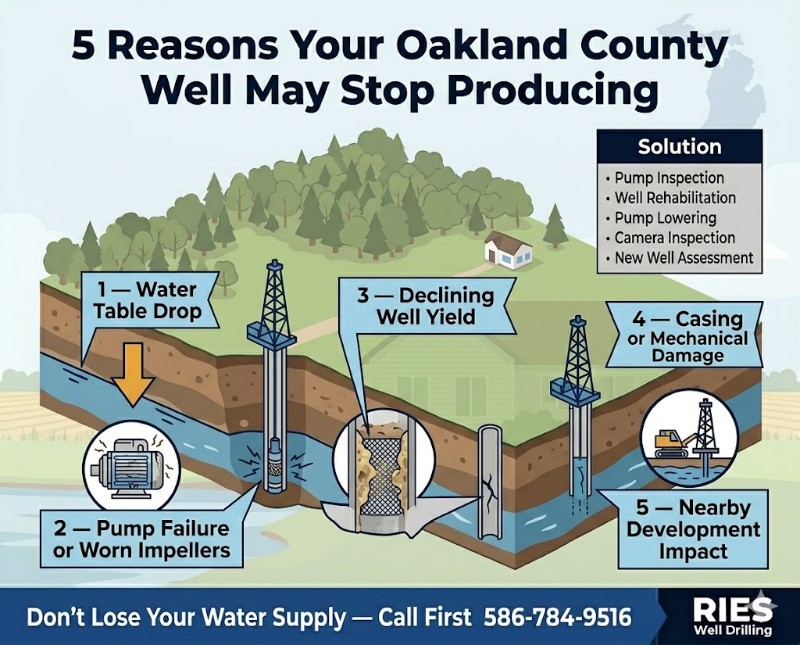
It’s one of the most alarming things that can happen to a homeowner on a private well: you turn on the faucet, and nothing comes out. Or a thin, sputtering stream replaces what was once solid pressure. If you’re in rural Oakland County — in Oakland Township, Addison Township, Brandon Township, Springfield Township, or one of the other communities where private wells are the norm — you may have experienced this, or know someone who has.
The phrase “the well ran dry” is part of the common vernacular, but the actual causes are more varied than the phrase suggests. Understanding what’s really happening underground is the first step toward knowing how to address it.
Ries Well Drilling has been serving Oakland County and the surrounding region since 1983. Here’s a straightforward explanation of why wells fail to produce water — and what can be done about it.
THE WELL DIDN’T NECESSARILY “RUN DRY”
When a well suddenly stops producing, many homeowners assume the worst: that the underground water supply has been depleted. In reality, the aquifer itself running out of water is rare for properly drilled residential wells in Oakland County. More commonly, there’s a problem with the well’s ability to access the water that’s there.
Understanding the distinction matters because the solutions are very different.
CAUSE 1: THE WATER TABLE HAS DROPPED BELOW THE PUMP INTAKE
Submersible well pumps are set at a specific depth within the well casing — ideally, well below the normal water level. But the water table isn’t static. It rises and falls with seasonal precipitation, drought conditions, and groundwater recharge cycles.
In Oakland County and the broader Southeast Michigan region, extended dry periods — particularly late-summer droughts — can temporarily lower the water table in some areas. If your pump’s intake drops below the current water level, it will draw air rather than water.
Shallow wells are more vulnerable to this than deeper drilled wells that reach a deeper aquifer. If your well is shallower than average and you’re experiencing water loss during dry periods, pump lowering — physically lowering the pump to a greater depth within the existing casing — may be a solution. In some cases, the existing well may not have sufficient depth, and well deepening or a new well may be required.
CAUSE 2: THE PUMP HAS FAILED OR LOST EFFICIENCY
A pump that has reached the end of its service life may no longer be able to lift water effectively. Worn impellers lose pumping efficiency, and a severely worn pump may produce little to no water flow even when the well itself has water available.
The test here is fairly straightforward: a technician can check the pump’s electrical performance and pull it to inspect condition. If the pump has failed, replacement restores full water production assuming the well itself is in good shape.
CAUSE 3: WELL YIELD DECLINE
This is what most people mean when they say the well “ran dry” — the well is no longer producing water at its original rate. This can happen for several reasons.
Some wells are drilled into aquifer formations that naturally decline in productivity over decades. Others experience a yield decline due to mineral encrustation of the well screen and perforations, which allow water to enter the casing. Over time, iron ochre, calcium carbonate, and other minerals can progressively clog the well screen, reducing the rate at which water can flow in from the surrounding formation.
Well rehabilitation — the process of cleaning and treating the wellbore to remove mineral buildup and restore screen permeability — can sometimes recover significant yield in a well that has declined. This involves specialized treatment and pumping procedures and is worth considering before writing off a declining well entirely.
CAUSE 4: MECHANICAL DAMAGE TO THE WELL
In some cases, the well casing itself has developed a problem — a crack, a collapsed section, or a joint failure that allows fine sediment or clay to infiltrate, restricting or blocking flow. This is more common in older wells and wells that were not properly constructed initially.
Inspection of the well by lowering a camera into the casing can reveal this type of problem. Depending on what the camera shows, repair options may include installing a casing liner or, in severe cases, a new well.
CAUSE 5: NEARBY CONSTRUCTION OR DEVELOPMENT
New well installations in the area can sometimes affect local groundwater dynamics, particularly if multiple deep wells draw from the same aquifer in a relatively small area. This is less common than the other causes but worth mentioning for Oakland Township, Brandon Township, and parts of Addison Township where development has been active in recent years.
WHAT SHOULD YOU DO IF YOUR WELL STOPS PRODUCING?
First, don’t panic — and don’t immediately assume you need a new well. Call Ries Well Drilling at 586-784-9516 and describe what you’re experiencing. They’ll walk through the diagnostic process:
Check the pressure tank and pump electrical system first, since these problems are the quickest to identify and often the easiest to fix. If those check out, pull and inspect the pump. If the pump is in working order, assess the well’s current water level and production rate. Based on those findings, they’ll advise on the best path forward — whether that’s pump lowering, well rehabilitation, or, in cases where the well is genuinely at the end of its life, a new well.
Ries Well Drilling serves Oakland Township, Addison Township, Brandon Township, Springfield Township, and communities throughout Oakland, Macomb, Lapeer, and St. Clair Counties. Call them at 586-784-9516 to start the diagnostic process.