
Oxford Township is one of Oakland County’s most established rural communities. Unlike the newer suburban buildouts pushing north through Macomb County, Oxford Township has a long history of rural residential living — large lots, wooded parcels, horse properties, and homes that have been in families for generations. And with that history comes something that newer communities are just beginning to deal with: aging well systems.
The majority of Oxford Township homes outside the Village of Oxford run on private wells. Municipal water service coverage is limited, which means thousands of households depend entirely on their well for drinking water, cooking, bathing, laundry, and irrigation. For most of those homeowners, the well is out of sight and largely out of mind — until something goes wrong.
Ries Well Drilling has been serving Oxford Township and Oakland County since 1983. What they consistently find when they respond to service calls in the area is that problems that could have been caught early — and fixed inexpensively — have been allowed to develop into major repairs because no one was paying attention to the well system. This guide is for Oxford Township homeowners who want to get ahead of that.
WHY WELL MAINTENANCE MATTERS MORE IN ESTABLISHED COMMUNITIES
In a newer development where every home was built in the last decade, most well systems are relatively young. Components are within their expected service life and failure rates are low. Oxford Township is different. Homes built in the 1960s, 1970s, and 1980s may have original well casings and pumps that have never been inspected or serviced in any meaningful way.
An aging well isn’t necessarily a failing well. A properly drilled and cased well can remain structurally sound for many decades. But the components inside and around the well — the pump, pressure tank, pressure switch, wiring, well cap, and pitless adapter — all have finite service lives. Ignoring them doesn’t extend those service lives; it just means you find out they’ve failed at the worst possible moment.
WHAT DOES A WELL INSPECTION COVER?
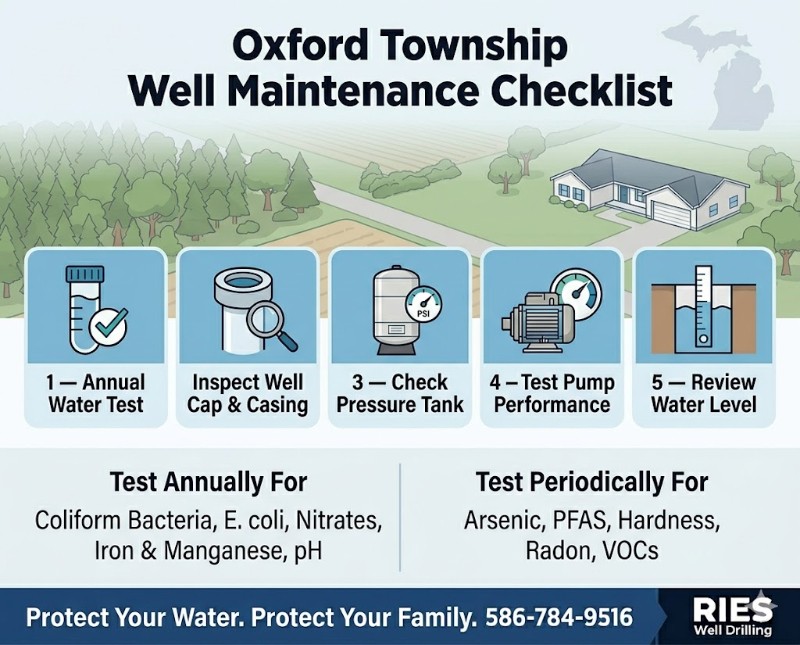
A professional well inspection from Ries Well Drilling evaluates the complete system from top to bottom. Here’s what that involves:
Well cap and casing inspection. The well cap sits on top of the casing and keeps insects, surface water, and debris out of the well. A cracked, ill-fitting, or missing well cap is an open door for contamination. The upper portion of the casing is also inspected for damage, corrosion, or improper sealing.
Pitless adapter inspection. The pitless adapter is the fitting that allows the water line to exit the well casing below the frost line. Older pitless adapters — particularly those made from brass or older materials — can corrode over time and develop leaks that allow contaminants to enter the well from outside the casing.
Pressure tank assessment. The technician checks the pressure tank’s air pre-charge, listens for short-cycling behavior, and inspects the tank for corrosion or waterlogging. A failing pressure tank is one of the most common well service issues in Oxford Township’s older housing stock.
Pump performance evaluation. Pump output, system pressure, and cycling behavior are assessed. A pump that’s losing efficiency may still be producing water but working much harder than it should, drawing excess electricity and heading toward failure.
Electrical components. The pressure switch, wiring connections, and electrical service to the pump are inspected for condition and safety.
Water level check. In some cases, a well that has historically produced strong flow may be experiencing reduced yield — either from aquifer changes, mineral screen encrustation, or pump positioning. A water level assessment helps identify these issues.
HOW OFTEN SHOULD YOUR WELL BE INSPECTED?
Michigan’s Department of Environment, Great Lakes, and Energy (EGLE) recommends that private well owners have their well inspected at least once every 10 years, and more frequently if the well is older or if there have been changes in water quality, pressure, or yield. For Oxford Township homeowners whose wells predate 1990, a current inspection is strongly advisable regardless of when the last one occurred.
A practical rule of thumb: if you’ve owned your home for more than five years and have never had a professional well inspection, schedule one. The cost is minimal compared to emergency pump replacement or the health consequences of drinking contaminated water.
WHAT SHOULD YOU TEST YOUR WELL WATER FOR?
Private well owners in Michigan are responsible for their own water quality testing — unlike municipal water customers, whose water is continuously monitored and treated by the utility. In Oxford Township and throughout rural Oakland County, water testing falls entirely to the homeowner.
At minimum, Michigan recommends annual testing for coliform bacteria, E. coli, and nitrates. These are the contaminants most likely to cause acute health effects and most likely to enter a well from surface contamination sources — a failing septic system, animal waste, or a compromised well cap.
Beyond the annual minimum, Oxford Township homeowners should consider periodic testing for:
Iron and manganese. Naturally occurring in many Oakland County aquifers, elevated iron and manganese don’t pose a direct health risk at typical levels but cause staining, off-taste, and appliance damage. Treatment options are available if levels are problematic.
Arsenic. Arsenic occurs naturally in some Michigan bedrock formations and has been found in private wells in parts of Oakland County. The EPA maximum contaminant level for arsenic is 10 parts per billion; testing is the only way to know your level.
PFAS. Per- and polyfluoroalkyl substances have been identified in groundwater in multiple locations across Southeast Michigan. While the highest-profile contamination sites have been near industrial and military facilities, the broader presence of PFAS in Michigan groundwater makes periodic testing prudent for private well owners throughout the region.
pH and hardness. Water that’s too acidic can corrode copper plumbing and fixtures over time. Hard water causes scale buildup in water heaters, pipes, and appliances. Both are treatable, but you need to know your levels first.
WHAT IF YOUR WATER QUALITY TEST REVEALS A PROBLEM?
A positive coliform or E. coli test result is an immediate action item — the well needs to be shocked with chlorine to disinfect it, and retested to confirm the contamination has been cleared. If contamination recurs after treatment, a more thorough investigation of the well’s structural integrity and the surrounding area is warranted.
Elevated mineral levels, arsenic, or PFAS findings trigger a different response — generally water treatment rather than well remediation, since these are naturally occurring or widespread contaminants rather than point-source problems. Ries Well Drilling can advise on appropriate next steps based on your specific test results.
WHERE TO GET YOUR WATER TESTED
Water testing for private wells must be done by a state-certified laboratory. Macomb County Health Department operates a water testing lab that serves surrounding counties including Oakland; private certified laboratories are also available. Your water sample needs to be collected and submitted according to the lab’s specific instructions to ensure accurate results.
SCHEDULE YOUR OXFORD TOWNSHIP WELL INSPECTION
If your Oxford Township home is on a private well and you haven’t had a professional inspection in recent years — or ever — call Ries Well Drilling at 586-784-9516. They serve Oxford Township, Addison Township, Brandon Township, Oakland Township, and communities throughout Oakland, Macomb, Lapeer, and St. Clair Counties. A well inspection is the single most effective step you can take to protect both your water quality and your well system investment.