
Addison Township is the kind of place people move to on purpose. It’s not a suburb that happened to grow up around a township — it’s genuinely rural Oakland County, with horse properties, hobby farms, wooded acreage parcels, and a quality of life that can’t be replicated in a subdivision. If you’re looking at land or an existing home in Addison Township, you probably already know what draws people here.
What you may not have thought about yet is the water system. Addison Township has virtually no municipal water infrastructure. Nearly every home in the township runs on a private well, and that well is now your responsibility — or will be, the moment you close on the property. Understanding what you’re taking on before you close is not just smart; it’s essential.
Ries Well Drilling has been drilling and servicing wells throughout Addison Township and Oakland County since 1983. This guide is specifically for buyers considering rural property in Addison Township who want to know the right questions to ask and the right steps to take before signing anything.
THE FIRST THING TO UNDERSTAND: YOU’RE INHERITING SOMEONE ELSE’S WELL
When you buy a home on city water, and the water heater fails, you replace the water heater. The water source itself is the utility’s responsibility. On a private well, the water source is yours — and if the well has problems, they become your problems the day you take title.
This isn’t a reason to avoid well properties. The vast majority of wells in Addison Township and rural Oakland County are functioning reliably. But it is a reason to do your due diligence before closing, rather than discovering issues after the fact.
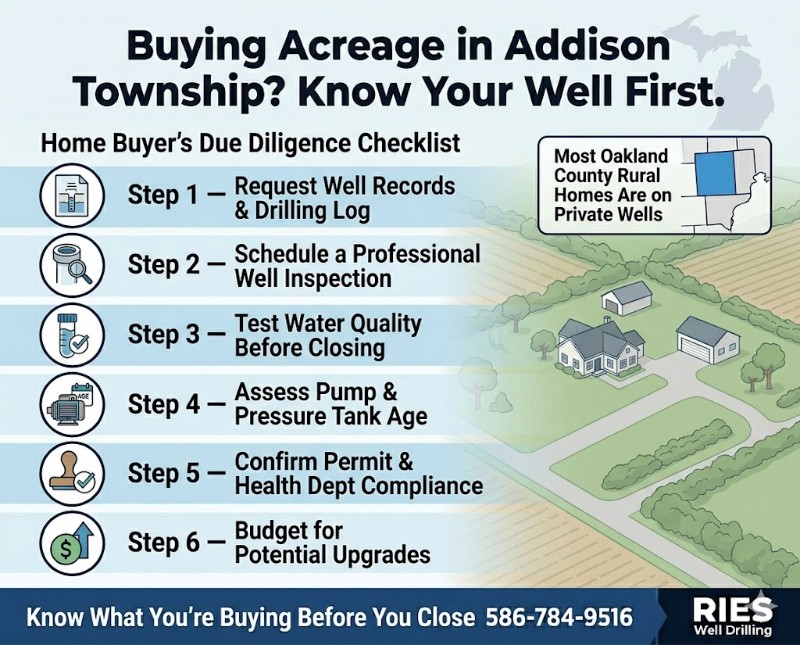
STEP 1: REQUEST THE WELL RECORDS
Every permitted well in Michigan has a drilling record on file with the state — a well log that documents the date of drilling, the driller, the well depth, the casing depth, the soil and rock layers encountered, and the depth at which water was found. This document tells you a great deal about the well before anyone sets foot on the property.
You can request well records through Michigan’s online well log database, or ask the seller to provide documentation. Key things to look for: how old is the well, how deep does it go, and was it drilled by a licensed contractor? A well drilled before Michigan’s current well construction code was in place may not meet current standards in some respects — not necessarily a dealbreaker, but worth knowing.
STEP 2: SCHEDULE A PROFESSIONAL WELL INSPECTION
A real estate home inspection covers the visible, accessible components of a home’s systems. Most general home inspectors are not well-versed in systems, and their inspection of the well is typically limited to checking whether water comes out of the faucet and whether the pressure seems reasonable. That’s not the same as a professional well system inspection.
Before closing on an Addison Township property, schedule a dedicated well inspection with Ries Well Drilling. A proper inspection includes assessment of the well cap and casing condition, pitless adapter integrity, pump performance and cycling behavior, pressure tank condition and pre-charge, electrical components, and overall system age and serviceability.
This inspection should happen during the due diligence period — before you’re committed to closing — so that any findings can be factored into your purchase decision or negotiation.
STEP 3: TEST THE WATER QUALITY
A professional well inspection assesses the mechanical and structural condition of the well system. It does not tell you about the water quality. Those are two separate things, and you need both.
Water quality testing for a property purchase should include at minimum: coliform bacteria, E. coli, and nitrates. These are the contaminants required by most lenders for properties with private wells, and they’re the ones most likely to affect your health directly.
Beyond the lender-required minimum, Addison Township buyers should strongly consider testing for:
Iron and manganese. Common in Oakland County groundwater, elevated levels stain fixtures and affect taste. Treatable, but worth knowing about before you move in.
Arsenic. Naturally occurring arsenic has been found in private wells in parts of Oakland County. Testing is the only way to know your level.
PFAS. Per- and polyfluoroalkyl substances have been detected in groundwater across parts of Southeast Michigan. A baseline PFAS test on a property you’re purchasing is prudent.
Hardness and pH. Hard water is common in this region and affects everything from your water heater’s efficiency to how your skin feels after a shower. Knowing the hardness level helps you plan for water treatment if needed.
Many lenders financing rural properties with private wells will require a water test as a condition of the loan. Even if yours doesn’t, get the test done for your own protection.
STEP 4: ASSESS THE AGE OF THE PUMP AND PRESSURE TANK
The well itself may be decades old and still structurally sound. But the pump inside the well and the pressure tank in the home have defined service lives. Submersible well pumps typically last 10 to 25 years depending on conditions, usage, and water quality. Pressure tanks last roughly 10 to 15 years before bladder failure becomes likely.
Ask the seller when the pump was last replaced. If they don’t know — which is common with older properties — the well inspection will give you a sense of the pump’s condition. If the pump is aging, factor in the potential replacement cost in your purchase calculation. A pump replacement in Addison Township is not an emergency if you plan for it; it absolutely is one if you discover you need it three months after moving in.
STEP 5: UNDERSTAND WHAT THE WELL CAN AND CAN’T TELL YOU ABOUT WATER SUPPLY
Well yield — how many gallons per minute the well can sustainably produce — is documented in the original drilling log. For a typical residential property, a yield of 3 to 5 gallons per minute or better is generally adequate for household use. A lower yield isn’t necessarily disqualifying, but it may affect irrigation capacity and the property’s ability to support additional demand.
Water table depth can vary seasonally, particularly in shallower wells. If you’re looking at a property with a relatively shallow well and you plan to use significant water for irrigation or livestock, it’s worth asking Ries Well Drilling to assess whether the well’s yield and depth can support that use.
STEP 6: KNOW WHAT YOU’RE BUYING BEFORE YOU CLOSE — NOT AFTER
The cost of a professional well inspection and water quality test before closing is a fraction of what it costs to address a major well problem after the fact. An emergency pump replacement, well rehabilitation, or discovery of contamination that requires ongoing water treatment — these are expensive surprises that due diligence can prevent.
Addison Township is a wonderful place to own property. Buyers who take the time to understand the well system they’re acquiring go into ownership with clear eyes — and that makes for a much better experience than discovering problems after the moving trucks leave.
READY TO SCHEDULE A PRE-PURCHASE WELL INSPECTION IN ADDISON TOWNSHIP?
Call Ries Well Drilling at 586-784-9516. They serve Addison Township, Oxford Township, Brandon Township, Oakland Township, and communities throughout Oakland, Macomb, Lapeer, and St. Clair Counties. They can schedule your inspection during the due diligence period and have results back to you in time to factor into your closing decision.