
Nobody thinks about their well pump until it stops working. That’s human nature. The pump sits at the bottom of the well casing, hidden underground, quietly doing its job day after day, year after year — until one morning you turn on the faucet and nothing comes out. Or worse, you wake up to a flooded basement because the pressure tank finally gave out.
For Armada Township residents and homeowners throughout northern Macomb County, a well pump failure isn’t just an inconvenience — it’s the loss of all household water. No drinking water, no showers, no flushing toilets. In rural communities where the nearest city water hookup isn’t an option, a failed pump is an emergency.
The good news is that well pumps rarely fail without warning. Most failing pumps give you weeks or even months of signals before they quit entirely. Knowing what to look for can be the difference between a planned repair during business hours and an emergency call on a Sunday night.
Ries Well Drilling has been responding to well pump calls throughout Armada Township, Bruce Township, Ray Township, Washington Township, and the broader Macomb County area since 1983. Here’s what they want you to know about the signs of a failing pump.
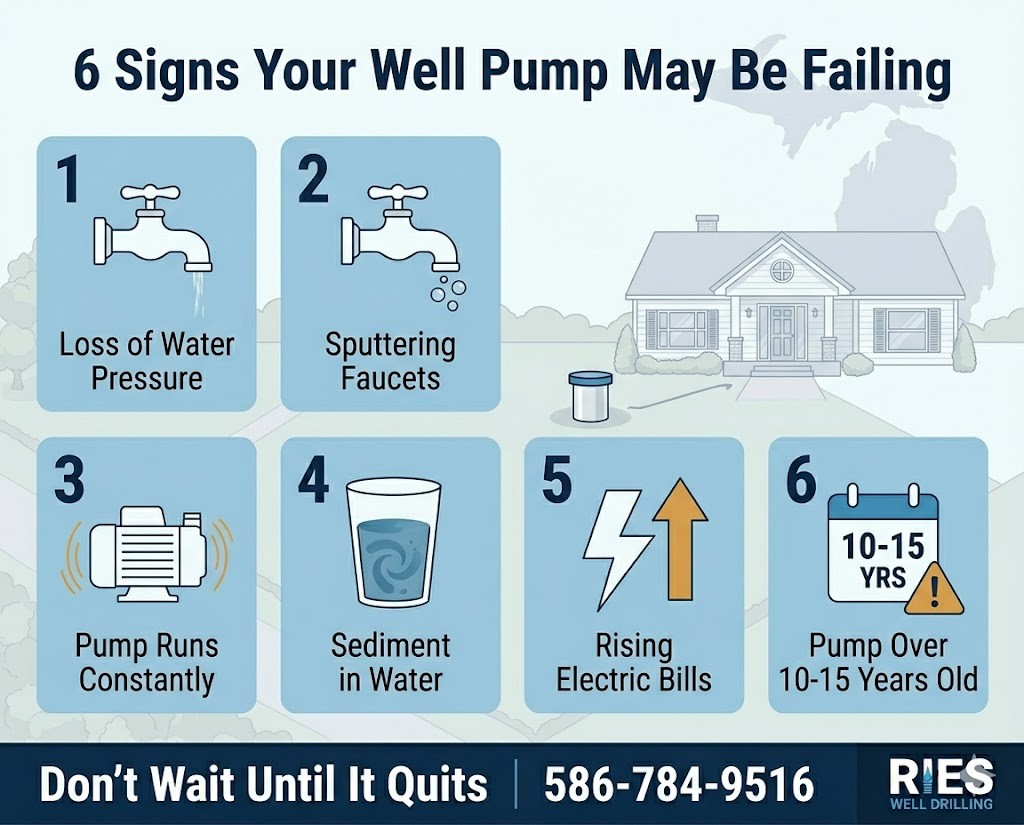
SIGN 1: LOSS OF WATER PRESSURE
A gradual decline in water pressure is one of the most common early signs that something is wrong with your well system. If your morning shower pressure has been noticeably weaker than it used to be, or if running two fixtures at once brings pressure down to a trickle when it never used to, don’t dismiss it.
Pressure loss can have several causes — a failing pump, a waterlogged pressure tank, a pressure switch that needs calibration, a partially clogged screen or drop pipe, or in some cases a drop in the water table. A well service technician can diagnose the actual cause, which matters because the fix is different depending on what’s driving the symptom.
SIGN 2: SPUTTERING WATER FROM FAUCETS
If air is entering your water supply, you’ll notice it as sputtering, spitting, or intermittent flow from faucets that used to run smoothly. This can indicate that the pump is losing prime, that the water table has dropped below the pump intake during dry conditions, or that the drop pipe has developed a leak allowing air infiltration.
Armada Township and rural Macomb County can experience water table fluctuations during drought periods, particularly in late summer. If you notice sputtering more during dry stretches, mention that to the technician — it helps narrow down the cause.
SIGN 3: PUMP RUNS CONSTANTLY OR SHORT-CYCLES
Your pump should run to fill the pressure tank, then shut off. Then, as you use water and pressure drops, it should cycle on again. A healthy system cycles a reasonable number of times per day. Two problems represent the extremes of this cycle behavior:
A pump that runs constantly without shutting off suggests it’s not able to build adequate pressure — possibly due to a worn pump, a significant drop pipe leak, or the pump intake running dry.
A pump that clicks on and off rapidly — sometimes called short-cycling — often indicates a waterlogged pressure tank. The tank contains an air bladder that provides a cushion between pump cycles. When the bladder fails, the tank fills completely with water, leaving no air cushion, and the pump must run with every small draw of water. Short-cycling puts enormous stress on the pump motor and dramatically shortens pump life.
If your pump is short-cycling, you may hear it clicking on for a few seconds every time you open a faucet. This is worth addressing promptly.
SIGN 4: VISIBLE SEDIMENT OR DISCOLORATION IN WATER
A sudden appearance of sand, silt, or murky water in a well that has previously produced clear water can indicate that the pump has dropped within the casing, that the well screen has deteriorated, or that the pump itself is pulling in material it shouldn’t be. Brown or rust-colored water may also indicate pump component corrosion.
Some cloudiness after an extended period of no use can be normal, but persistent discoloration or sediment is a signal to have the system checked.
SIGN 5: HIGH ELECTRICITY BILLS WITHOUT EXPLANATION
Well pumps are electric, and a pump that’s working harder than it should — straining against low water levels, running continuously, or compensating for a pressure system problem — will draw more current than a healthy system. If your electric bill has crept up without an obvious explanation, and you’re on a well, it’s worth asking your well service provider to check pump performance.
SIGN 6: THE PUMP IS MORE THAN 10-15 YEARS OLD
Submersible well pumps are not designed to last forever. Quality pumps installed by experienced contractors in proper conditions can run 15, even 20 years in some cases. But as a pump ages, its efficiency declines and the probability of failure increases. If your pump is pushing 15 years old, it’s worth having it assessed even if it seems to be working fine. Proactive replacement on your schedule is almost always less expensive and less disruptive than emergency replacement when the pump fails without warning.
WHAT TO DO IF YOU SUSPECT YOUR PUMP IS FAILING
Don’t wait. The sooner a problem is diagnosed, the more options you have for the repair. A pump that’s losing efficiency but still running gives your technician time to assess and plan. A pump that has completely failed means you need service immediately, which may limit scheduling flexibility.
Call Ries Well Drilling at 586-784-9516. They serve Armada Township, Bruce Township, Lenox Township, Ray Township, Washington Township, and communities throughout Macomb, Oakland, Lapeer, and St. Clair Counties. They provide well pump service and repair, pressure tank replacement, well inspections, and complete well system assessments.