
Water defines St. Clair County. The St. Clair River, Lake St. Clair, and miles of inland waterways give the county its identity — and its nickname, Michigan’s Blue Water County. But for the thousands of families who live in the county’s rural townships, the water that matters most every single day isn’t the river or the lake. It’s the water coming out of their kitchen faucet, their shower, and their garden hose. And in communities like Clay Township and Cottrellville Township, that water comes from underground.
Municipal water infrastructure is sparse across much of rural St. Clair County. While waterfront communities along the St. Clair River corridor have some utility service, most residential properties in Clay Township, Cottrellville Township, China Township, Ira Township, and similar communities depend entirely on private wells. If you’re buying land, building a home, or replacing an aging well system in St. Clair County, understanding the process is the first step to getting it done right.
Ries Well Drilling has drilled and serviced wells in St. Clair County since 1983. Here’s what homeowners and builders in Clay Township and Cottrellville need to know.
ST. CLAIR COUNTY GEOLOGY: WHAT’S UNDERGROUND
One of the first questions homeowners ask about well drilling is how deep the well needs to go. The honest answer is that depth varies by location — and understanding why requires a brief look at what’s actually underground in St. Clair County.
The county sits atop a sequence of glacial deposits — sand, gravel, clay, and till left behind by retreating glaciers — overlying sedimentary bedrock that includes sandstone, limestone, and shale formations. Water can be found in both the glacial materials and the bedrock, depending on local conditions.
In Clay Township and Cottrellville Township, wells often encounter productive water-bearing zones in glacial sand and gravel formations at shallower depths, though bedrock wells are also drilled in areas where the glacial materials don’t yield adequate quantity or quality. Bedrock wells tend to offer better protection from surface contamination but may have naturally elevated mineral content—particularly iron, hardness, and, in some areas, hydrogen sulfide.
Ries Well Drilling draws on decades of local drilling experience and Michigan’s well log database to estimate what to expect at a specific property before the drill rig arrives. That local knowledge matters — a driller who has worked extensively in St. Clair County will have a much more accurate picture of subsurface conditions than someone working in the area for the first time.
THE PERMITTING PROCESS IN ST. CLAIR COUNTY
Well installation in St. Clair County requires a permit from the St. Clair County Health Department. The permit application triggers a review of proposed well placement, setback compliance from septic systems and potential contamination sources, and approval of the drilling location before work can begin.
Setback requirements under Michigan’s Well Construction and Pump Installation Code specify minimum distances between a well and septic system components, property lines, fuel storage, and other potential contamination sources. On rural St. Clair County properties where septic systems are also common, proper coordination between well and septic placement is essential — and ideally happens before either system is installed.
Ries Well Drilling manages the permitting process on behalf of their clients throughout St. Clair County, as they do in Macomb, Oakland, and Lapeer Counties. You don’t have to navigate the Health Department paperwork yourself.
WHAT A COMPLETE WELL INSTALLATION INCLUDES
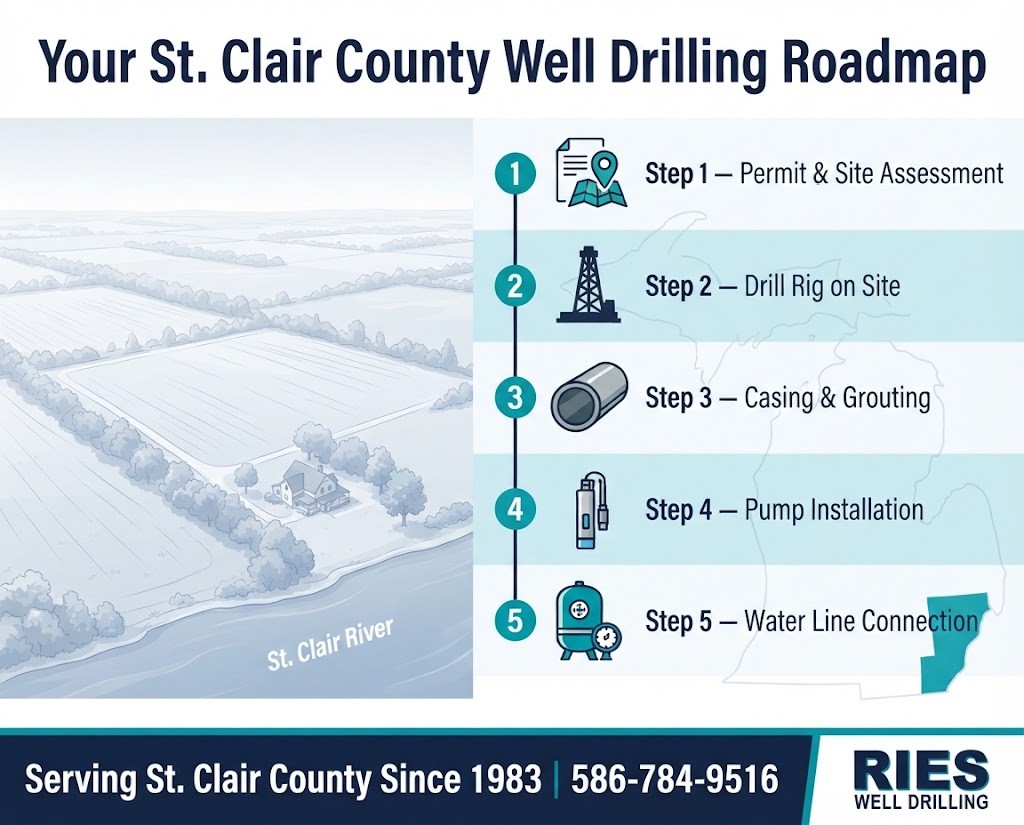
A complete residential well installation in Clay Township, Cottrellville, or elsewhere in rural St. Clair County involves more than drilling. Here’s what a complete system looks like:
The borehole. Drilled to the depth required to reach a productive, clean water source. In St. Clair County, this typically ranges from 60 to 200 feet depending on location, though some properties require going deeper.
Steel casing. Driven from the surface into the borehole to bedrock or to the minimum grouted depth required by Michigan regulations. The casing protects the well from surface water infiltration and provides structural integrity for the bore hole.
Grouted annular seal. Bentonite or neat cement grout is placed around the outside of the casing in the upper portion of the borehole. This critical step prevents surface runoff — and any contaminants it carries — from migrating downward alongside the casing into the water supply.
Submersible pump and drop pipe. Sized to match your household water demand and the well’s production capacity, then lowered into the casing to the appropriate depth.
Pitless adapter and well cap. The pitless adapter allows the buried water line to exit the casing below the frost line. The sanitary well cap seals the top of the casing against insects, small animals, and surface water.
Pressure tank and pressure switch. Typically installed inside the home or an outbuilding, these components regulate system pressure and protect the pump from short-cycling.
Water line to the home. The buried supply line running from the well to the home’s plumbing system. This is typically bid as part of the complete installation.
WATER QUALITY IN CLAY TOWNSHIP AND COTTRELLVILLE
St. Clair County’s rural townships have specific water quality considerations that homeowners should know before and after well installation.
Iron is common in many parts of St. Clair County’s groundwater. Elevated iron doesn’t make water unsafe, but it can cause orange staining on fixtures, laundry, and concrete; affect taste; and damage appliances over time. Water treatment options — iron filters, water softeners, or combination systems — can address this effectively once you know your iron level.
Agricultural activity in parts of Clay and Cottrellville Townships means nitrate contamination from fertilizer application is a relevant concern, particularly for shallower wells. Annual nitrate testing is strongly recommended for any well in an agricultural area.
PFAS contamination has been identified in groundwater in multiple locations across Michigan. While St. Clair County has not been among the highest-profile PFAS contamination areas, baseline testing is prudent for any new well installation or property purchase.
Hardness is widespread in Southeast Michigan groundwater, including St. Clair County. Hard water isn’t a health concern, but it affects water heater efficiency, pipe scale buildup, and soap performance. A water softener is a common addition to St. Clair County well systems.
PLANNING YOUR PROJECT
Whether you’re drilling a new well for new construction, replacing an aging system on an existing property, or evaluating a well on a home you’re considering purchasing, Ries Well Drilling is ready to help St. Clair County homeowners at every step.
A site assessment is the best place to start. Ries Well Drilling will review your property, consult local well records, and provide a detailed, itemized estimate before you commit. Lead times for well drilling extend during busy seasons, so contacting us early is always best.
Call Ries Well Drilling at 586-784-9516. They serve Clay Township, Cottrellville Township, China Township, Ira Township, Riley Township, and communities throughout St. Clair, Macomb, Oakland, and Lapeer Counties.