
If your home is connected to a municipal water system, testing and treatment happen in the background — the utility tests continuously, reports results annually, and treats the water before it reaches your tap. You might never think about what’s in your water because someone else is thinking about it for you.
Private well owners don’t have that luxury. In Michigan, private well testing and treatment is entirely the homeowner’s responsibility. No utility monitors your well, no automatic notification if something changes in your groundwater, and no regulatory requirement for anyone to test your water at all. If you don’t test it, it doesn’t get tested.
This matters more than many well owners realize. Groundwater quality can change over time — seasonally, due to nearby land use changes, because of aging well components, or simply because of natural variations in the aquifer. Water that tested clean five years ago may not be the same water you’re drinking today.
Ries Well Drilling has been serving private well owners throughout Macomb, Oakland, Lapeer, and St. Clair Counties since 1983. Here’s a straightforward guide to what you should be testing for, how often, and what to do if your results come back with problems.
WHY PRIVATE WELL TESTING IS DIFFERENT FROM CITY WATER
Municipal water systems are regulated under the federal Safe Drinking Water Act and must meet EPA standards for dozens of contaminants, tested continuously and reported publicly. Private wells serving fewer than 25 people are explicitly excluded from those federal regulations. Michigan has its own guidelines for private well testing, but they are recommendations, not requirements — there is no enforcement mechanism that compels a private well owner to test their water.
This regulatory gap places the burden squarely on the homeowner. It also means that the risk is real: the CDC estimates that roughly 1 in 5 private wells in the United States contains at least one contaminant at levels that exceed health-based guidelines. In agricultural states like Michigan, where nitrate contamination from fertilizer application is common and naturally occurring minerals like arsenic are present in some aquifer formations, that risk is not theoretical.
WHAT YOU SHOULD TEST FOR ANNUALLY
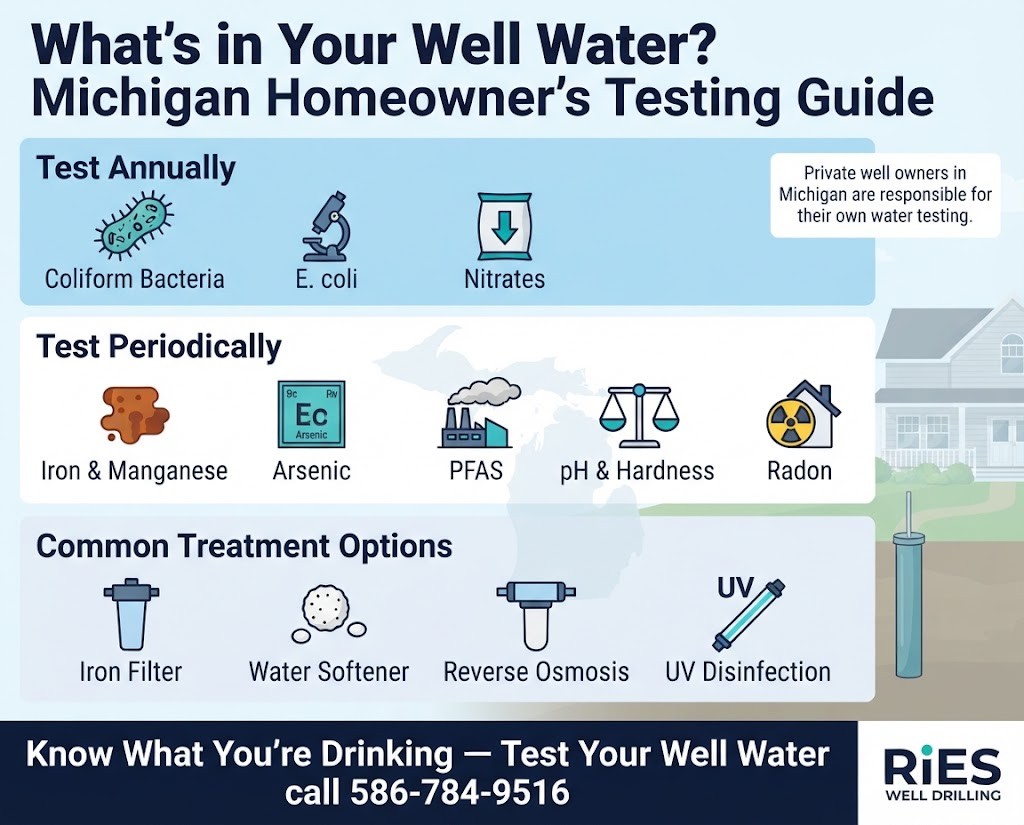
Michigan’s Department of Environment, Great Lakes, and Energy (EGLE) recommends annual testing of private wells at minimum for the following:
Coliform bacteria. Total coliform bacteria are used as an indicator of general microbial contamination in water. Their presence doesn’t necessarily mean the specific bacteria present are harmful, but it indicates that contamination pathways exist that could allow harmful organisms to enter the well. A positive coliform result requires immediate follow-up.
E. coli. Escherichia coli is a specific type of coliform bacteria that indicates fecal contamination — from a failing septic system, animal waste, or surface runoff entering the well. E. coli in drinking water is a direct health concern and requires immediate action: disinfection of the well and retesting to confirm clearance.
Nitrates. Nitrate contamination in groundwater is strongly associated with agricultural fertilizer application, septic system effluent, and animal waste. Elevated nitrates are particularly dangerous for infants under six months of age, in whom they can cause a potentially fatal condition called methemoglobinemia (blue baby syndrome). The EPA maximum contaminant level for nitrates is 10 milligrams per liter. For homeowners in Macomb County’s agricultural townships — Armada, Bruce, Ray, Lenox — and throughout rural Lapeer and St. Clair Counties where crop farming is prevalent, nitrate testing is especially important.
WHAT YOU SHOULD TEST FOR PERIODICALLY
Beyond the annual minimum, several additional parameters are worth testing periodically—every three to five years, or whenever you notice changes in water quality.
Iron and manganese. Both occur naturally in Michigan groundwater and are common throughout the Macomb, Oakland, Lapeer, and St. Clair County aquifers. At elevated levels, iron causes orange-brown staining on fixtures, laundry, and concrete surfaces; manganese can cause black or gray staining. Neither poses a direct health risk at typical levels, but elevated manganese has been associated with neurological effects at very high concentrations. Both are treatable with iron filters or water softeners once you know the levels.
Arsenic. Private wells across Michigan have been found to contain naturally occurring arsenic from bedrock dissolution, including in parts of Oakland and Lapeer Counties. The EPA maximum contaminant level for arsenic is 10 parts per billion; some health authorities argue that even lower levels carry risk with long-term exposure. Testing is the only way to know your level. Reverse osmosis or iron-based adsorption media can treat water when arsenic is present.
PFAS. Per- and polyfluoroalkyl substances are a group of synthetic chemicals used in industrial and consumer products for decades and now found in groundwater across much of Michigan. Several Michigan communities have faced significant PFAS contamination, primarily near industrial facilities and military bases. While the highest-profile contamination sites in Southeast Michigan have been associated with specific sources, PFAS has also been detected at lower levels in groundwater more broadly. A baseline PFAS test is prudent for any private well owner in the region, particularly if you haven’t tested in recent years.
pH and hardness. Water that’s too acidic (low pH) can corrode copper pipes and fixtures over time, leaching copper into your drinking water and damaging your plumbing system. Hard water — high calcium and magnesium content — is extremely common in Southeast Michigan and causes scale buildup in water heaters, dishwashers, and pipes, reduces soap effectiveness, and affects skin and hair. Water treatment can address both issues once you know your levels.
Radon. Radon is a naturally occurring radioactive gas that can dissolve into groundwater from surrounding rock. While it’s more commonly a concern as an airborne gas in basements, radon in well water can be released into indoor air during showering and other water use. Testing is available and treatment options exist if levels are elevated.
HOW TO GET YOUR WELL WATER TESTED
Private well water testing must be done by a state-certified laboratory to be reliable and valid. Macomb County Health Department operates a water testing laboratory that accepts samples from private well owners; private certified labs are also available throughout the region.
Testing kits from the hardware store are not a substitute for certified laboratory analysis. They may provide a rough screen for some parameters but aren’t accurate enough to base health decisions on, and they don’t cover the range of contaminants a certified lab test does.
When collecting a water sample for testing, follow the lab’s specific collection instructions carefully. Sample collection errors — using the wrong container, failing to run the tap for the specified time before sampling, contaminating the sample during collection — are a common cause of inaccurate results.
WHAT TO DO IF YOUR TEST RESULTS SHOW A PROBLEM
A positive coliform or E. coli result requires shock chlorination of the well — a disinfection process in which a concentrated chlorine solution is introduced into the well and circulated through the system, then flushed out. After treatment, retest the well to confirm the contamination is cleared. If contamination recurs after treatment, the well’s structural integrity — particularly the well cap, casing, and pitless adapter — should be inspected for pathways that are allowing surface water or contaminants to enter.
Elevated nitrates, arsenic, or PFAS are addressed differently — typically through point-of-use or whole-house treatment systems rather than well remediation, since these are widespread or naturally occurring contaminants rather than point-source problems. Reverse osmosis systems effectively remove nitrates, arsenic, and many PFAS compounds. Ries Well Drilling can advise on treatment options appropriate to your specific water quality findings.
Elevated iron or manganese, high hardness, or pH issues are typically addressed with water softeners, iron filters, or neutralizing filters. Treatment selection depends on the specific levels and combination of issues present.
SCHEDULE YOUR WATER TEST TODAY
If you haven’t tested your well water in the past year — or if you’ve never tested since moving into your home — now is the right time. Ries Well Drilling serves private well owners throughout Macomb, Oakland, Lapeer, and St. Clair Counties and can advise on appropriate testing for your specific area and well characteristics. Call them at 586-784-9516 to get started.