
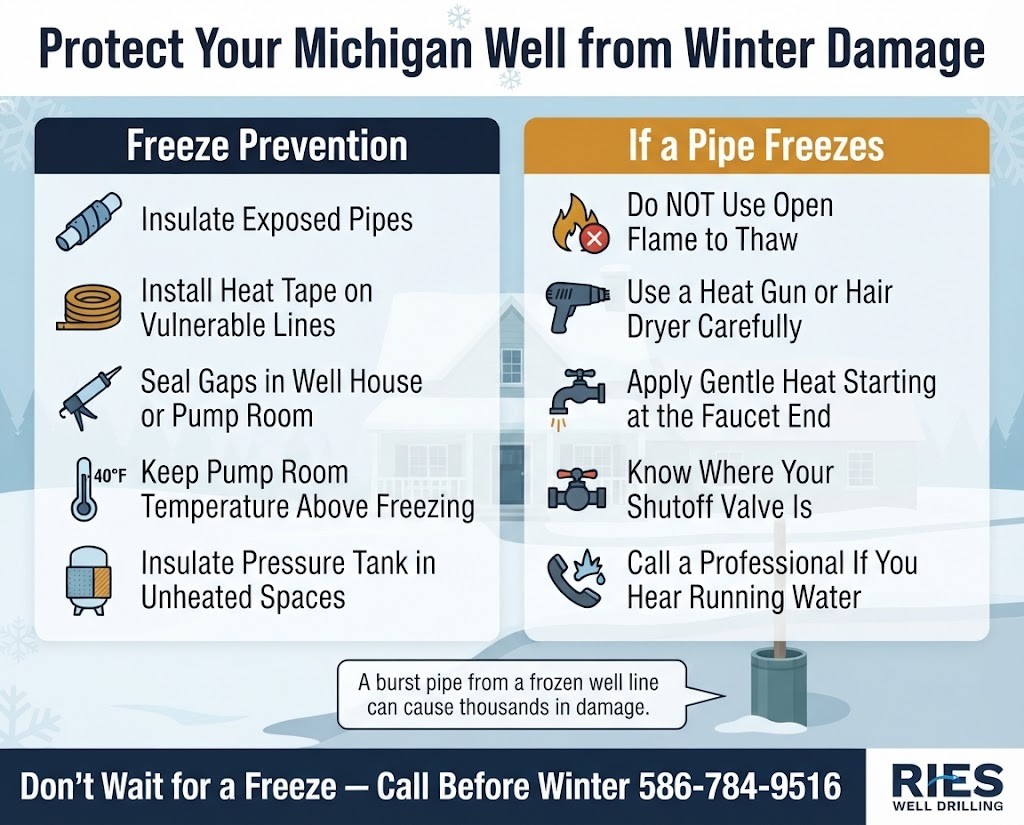
Michigan winters don’t negotiate. When a polar vortex pushes temperatures into the single digits for a week straight — as it does most winters in Macomb, Oakland, Lapeer, and St. Clair Counties — every water system in the region gets tested. Municipal water mains are buried deep, insulated, and monitored around the clock. Your private well system is your responsibility, and if you don’t protect its vulnerable parts before the cold arrives, the consequences can range from an inconvenient service call to thousands of dollars in damage.
The good news is that a properly installed, well-maintained residential well system is designed to handle Michigan winters without issue. The underground portions — the well casing, the buried water line, the pitless adapter below the frost line — are protected by the earth itself. The vulnerabilities are the components that cross from underground to above ground, and the equipment that sits in spaces that aren’t reliably heated.
Ries Well Drilling responds to freeze-related well service calls every winter throughout Southeast Michigan. Here’s what they recommend to prevent those calls from being yours.
UNDERSTAND WHERE YOUR SYSTEM IS VULNERABLE
The first step in winterizing your well system is knowing where the freeze risks actually are. Not all parts of your system are equally exposed.
The well casing itself is underground and not at risk. The buried water line from the well to your home runs below the frost line — in Michigan, that means at least 42 to 48 inches of depth — and is similarly protected. These components don’t freeze under normal conditions.
The vulnerable points are:
The pitless adapter connection at the well casing, just below grade. This is generally well protected, but on older installations or those where the soil has settled, it can be closer to the surface than ideal.
The water line where it transitions from underground to inside the home — typically where it enters through the foundation wall or floor. This transition point can be exposed to cold air infiltration if the penetration isn’t properly sealed.
Exposed plumbing inside unheated or poorly heated spaces — crawl spaces, unheated garages, outbuildings, utility rooms that lose heat quickly during cold snaps.
The pressure tank, if located in a space that isn’t reliably heated. A frozen pressure tank can be damaged internally, and the connected pipes can burst.
Outdoor fixtures — hose bibs, irrigation connections, and water lines to outbuildings — that weren’t properly winterized in the fall.
INSULATE EXPOSED PIPES BEFORE THE COLD ARRIVES
Any water pipe that runs through an unheated or partially heated space should be insulated before winter. Foam pipe insulation is inexpensive and easy to install — measure the pipe diameter, buy the corresponding foam sleeve, slit it along its length, and snap it onto the pipe. For standard residential pipe sizes, the materials cost is minimal and the protection is meaningful.
Pay particular attention to:
Pipes in crawl spaces, especially crawl spaces with vented foundation walls. Cold air flowing through crawl space vents during a cold snap can quickly freeze uninsulated pipes.
The section of pipe where the water line enters the home through the foundation. If there’s a gap between the pipe and the foundation penetration, seal it with spray foam or caulk to block cold-air infiltration.
Any pipe that runs along an exterior wall where insulation may be inadequate.
HEAT TAPE FOR HIGH-RISK LOCATIONS
For pipes that are particularly vulnerable—a section that runs through an unheated garage, a water line to an outbuilding, or a transition point that’s difficult to insulate adequately —self-regulating heat tape provides active freeze protection.
Self-regulating heat tape is a flexible electrical heating element that wraps around a pipe and automatically adjusts its heat output based on surrounding temperature — running harder when it’s colder and backing off when the temperature rises. It’s plugged into a standard outlet and draws power only when needed.
When installing heat tape, follow the manufacturer’s instructions exactly. Improper installation — overlapping the tape on itself, using the wrong type for the application, covering it with non-approved insulation — can create a fire hazard. Inspect existing heat tape installations annually for damage to the outer jacket before winter; replace damaged heat tape, don’t reuse it.
KEEP VULNERABLE SPACES ABOVE FREEZING
If your pressure tank, pump control panel, or any well system components are located in a space that isn’t part of your home’s heated envelope—a garage, a well house, an outbuilding—that space needs to stay above freezing during cold weather events.
Forty degrees Fahrenheit is the practical minimum for a space containing water system components. During a Michigan cold snap that pushes outdoor temperatures to minus ten, an uninsulated structure attached to a heated home can drop well below freezing without a supplemental heat source.
Options for keeping vulnerable spaces warm include:
A small electric space heater with a thermostat set to maintain a minimum temperature. Choose one rated for unattended operation and keep it away from flammable materials.
Heat lamps directed at vulnerable components. Less efficient than a thermostat-controlled heater but effective for targeted protection of specific components.
Improve insulation in the space itself—adding insulation to walls, the ceiling, and any overhead doors reduces heat loss and makes the space easier to keep above freezing.
WINTERIZE OUTDOOR FIXTURES COMPLETELY
Winterize every outdoor hose bib, irrigation system connection, and water line to an outbuilding or animal watering station before the first hard freeze.
For standard frost-free hose bibs: disconnect all hoses before cold weather. A hose left attached to a frost-free bib traps water in the valve body and defeats the freeze protection the bib is designed to provide. With the hose disconnected, open the bib to confirm it drains, then close it.
For irrigation systems on well water: a professional blowout with compressed air is the most thorough approach. Water left in lateral lines, risers, and sprinkler heads will freeze and expand, cracking components that can be expensive to replace in spring.
For water lines to outbuildings: if the line has a shutoff valve and drain inside the heated space, close the valve and open the drain to empty the line. If there’s no shutoff, heat tape or insulation — or both — is the protection strategy.
WHAT TO DO IF A PIPE FREEZES
Despite precautions, freezes happen. If you turn on a faucet and get no water during a cold snap, a frozen pipe is a likely cause. Here’s the right approach:
Identify the frozen section. If water flows from some fixtures but not others, the freeze is likely in the line serving the non-functioning fixtures. If nothing flows anywhere, the freeze may be in the main line entering the home.
Never use an open flame to thaw pipes. A propane torch or other open flame applied to a frozen pipe is a fire hazard — the pipe can conduct heat to surrounding materials and ignite a fire inside a wall or floor cavity. This rule has no exceptions.
Use a hair dryer or heat gun on a low setting, starting at the faucet end of the frozen section and working back toward the supply. Keep the affected faucet open so steam and water can escape as the ice melts.
Apply heat slowly and patiently. Aggressive heating of a frozen pipe can cause it to burst from steam pressure building behind the ice plug.
If you hear running water inside a wall when the freeze thaws, shut off your well pump at the pressure switch or circuit breaker immediately and call for service. Running water inside a wall means a pipe has burst and water is flowing into your structure.
WHEN TO CALL Ries Well Drilling
If you’re uncertain whether your system is adequately protected heading into winter, a pre-season service call from Ries Well Drilling is the most reliable way to find out. They’ll assess vulnerable points in your specific installation and advise on the protection measures appropriate for your home.
If a freeze has already damaged your system — a burst pipe, a failed pressure tank, pump damage from running dry after a line froze — call 586-784-9516 for service. Ries Well Drilling serves homeowners throughout Macomb County (Washington Township, Armada, Bruce, Ray, Lenox, Shelby, Chesterfield, Macomb Township), Oakland County (Oxford, Addison, Brandon, Oakland Township), Lapeer County (Metamora, Hadley, Dryden), and St. Clair County (Clay, Cottrellville, China, Ira Township).