
October in rural Michigan is spectacular. The maples turn orange and red, the oaks turn russet and gold, and the air carries that particular crispness that comes only in the weeks between summer and winter. For homeowners on wooded lots throughout Macomb, Oakland, Lapeer, and St. Clair Counties, it’s also the season of the endless leaf.
Most of what those leaves land on — the lawn, the driveway, the garden beds — presents no particular problem. But one outdoor feature deserves extra attention during fall yard cleanup: your well casing. The short pipe protruding from the ground that marks your water supply is not just landscaping infrastructure. It’s the surface entry point to your household water system, and what accumulates around and on top of it matters more than most homeowners realize.
Ries Well Drilling has been serving private well owners throughout Southeast Michigan for over four decades. Here’s why fall leaves and debris around your wellhead are worth paying attention to—and what to do about it.
WHY A LEAF PILE NEAR YOUR WELL IS MORE THAN AN EYESORE
When leaves, pine needles, grass clippings, and yard debris accumulate around the base of a well casing, several problems can develop over time. None are dramatic in the short term — but all are avoidable, and avoiding them is easier than dealing with the consequences.
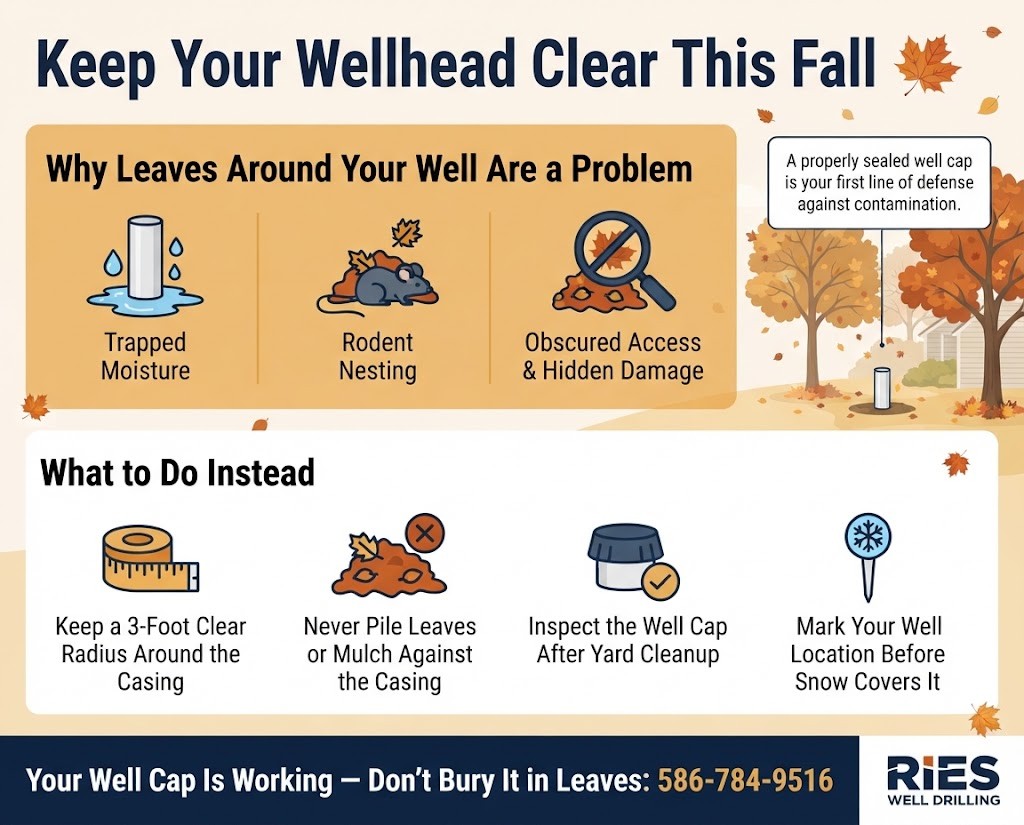
Trapped moisture against the casing. Wet leaves hold moisture against whatever they contact for extended periods. The upper portion of your well casing protrudes above ground for a reason — it’s the protected entry point to your water supply. Steel casing that stays wet through repeated freeze-thaw cycles corrodes faster than casing that drains and dries. Corrosion of the upper casing section isn’t catastrophic in months, but it compounds over years of autumn leaf accumulation.
Rodent access and nesting. A pile of leaves, yard waste, or mulch against the base of a well casing creates exactly the kind of sheltered, insulated environment that mice and voles look for as temperatures drop in October and November. Rodents don’t need much of a gap to investigate—and the space between accumulated yard debris and the well casing gives them cover to find entry points around the casing or cap. Rodents nesting near a well can chew through electrical wiring serving the pump and, over time, compromise casing integrity.
Obscured access and hidden damage. A well casing buried in leaves is a well casing you can’t easily inspect. Leaves that have been sitting against the base of the casing for months may be concealing early-stage corrosion, pest activity, or ground settlement that has affected the casing’s above-grade exposure. Keeping the area clear lets you see what’s there.
THE WELL CAP: YOUR PRIMARY CONTAMINATION BARRIER
The sanitary well cap sitting on top of your casing is the single most important line of defense against surface contamination entering your water supply. A properly installed, intact well cap with screened vents keeps insects, small animals, surface water, and debris out of the well bore.
The concern with autumn leaves isn’t primarily that a leaf pile will penetrate a properly functioning cap — a good cap prevents that. The concern is that leaves obscure the cap and prevent you from noticing when it isn’t functioning properly. Leaves that pack tightly against the cap and hold moisture against the seal over multiple wet fall and winter cycles can accelerate degradation of the rubber components. And a cap that gets bumped, cracked, or loosened during enthusiastic fall yard cleanup — by a rake handle, a wheelbarrow, or a powered yard tool — may be damaged in ways you won’t notice until the next water quality test comes back with a problem.
October is the right time to look at your well cap. Pull aside any accumulated debris, inspect the cap for cracks or damage, confirm it’s seated firmly and level on the casing, and make sure any vents are screened and clear of obstruction. If the cap looks worn, cracked, or ill-fitting, replacement is an inexpensive repair that provides significant protection value.
WHAT TO DO WITH LEAVES NEAR YOUR WELL
The practical guidance is simple. Maintain a clear radius of at least two to three feet around your well casing — no leaf piles, no mulch, no yard waste, no decorative landscaping material that holds moisture against the casing.
When you’re raking, blowing, or mulching leaves near your well, direct material away from the casing rather than toward it. If you use a riding mower with a bagger or discharge chute, be aware of where material is being directed near the well area.
If you’re having your lawn or landscape professionally serviced in the fall, make sure the crew knows the well location and understands that the casing area should be kept clear. A thirty-second conversation can prevent months of debris buildup.
MARK YOUR WELL BEFORE THE FIRST SNOW
October is also the month to mark your well casing location for winter. Once snow covers the ground, an unmarked well casing can be invisible — and invisible means it’s at risk from snowblowers, plows, shovels, and vehicles that don’t know it’s there.
A simple wooden stake or brightly colored marker placed within a foot or two of the casing, installed before the first significant snowfall, is all that’s needed. Mark it now, in October, when the ground is still accessible, and the casing is still visible.
WHEN TO CALL FOR INSPECTION
If a fall inspection of your well cap reveals cracking, improper fit, missing screens, or any visible damage, call Ries Well Drilling at 586-784-9516 to schedule a cap inspection and replacement. If the casing itself shows signs of corrosion, unusual settling, or physical damage, that warrants a more thorough evaluation.
Ries Well Drilling serves private well owners throughout Macomb County, Oakland County, Lapeer County, and St. Clair County. Fall is one of the best times to schedule a well system inspection — conditions are still workable, and there’s time to address any findings before winter.