
If you live in Richmond or Lenox Township — or anywhere in the rural stretches of northeastern Macomb County — your home runs on a private well. It’s simply how water works out here. The municipal water grid that serves denser suburban communities hasn’t extended into the rural townships, and for most homeowners in Richmond, Lenox, Ray, and Armada Township, that’s unlikely to change.
What changes over time is the technology available for your well system. If your home was built more than 15 years ago, it almost certainly uses a traditional pressure system — a fixed-speed pump cycling on and off to maintain pressure within a defined range. It works. Millions of homes use it. But there’s a newer alternative that’s been gaining popularity rapidly: constant pressure.
This guide explains the real differences between variable-pressure (traditional) and constant-pressure systems, so Richmond and Lenox Township homeowners can make an informed decision when their system comes up for replacement or an upgrade.
HOW A TRADITIONAL (VARIABLE PRESSURE) WELL SYSTEM WORKS
In a traditional system, a submersible pump at the bottom of your well casing runs at full speed to push water up to a pressure tank. The pressure tank has an air bladder inside that gets compressed as water fills the tank. When the system pressure reaches the cutoff point — commonly 50 or 60 PSI — the pump shuts off. As you use water, it drains from the tank and pressure drops. When pressure falls to the cut-in threshold — commonly 30 or 40 PSI — the pump kicks on again.
This cycle repeats continuously. In a home with typical water use, the pump might cycle dozens of times per day.
The pressure your fixtures experience depends on where you are in the cycle. Right after the pump shuts off, the pressure is at its maximum. Just before the pump kicks on, you have minimum pressure. If several fixtures are running simultaneously and demand exceeds the tank’s reserve, pressure drops toward the lower end of the range — sometimes noticeably.
HOW A CONSTANT PRESSURE WELL SYSTEM WORKS
A constant pressure system uses the same submersible pump in the same well, but adds a variable frequency drive (VFD) controller between the electrical supply and the pump motor. The controller monitors system pressure continuously and adjusts the pump motor’s speed to match current demand in real time.
If one person is running a single faucet, the pump runs at low speed. If the morning rush hits — showers, dishwasher, coffee maker, and a toilet refilling simultaneously — the pump speeds up to meet demand. Throughout it all, system pressure remains at a fixed setpoint, typically 60 PSI.
The pump doesn’t cycle on and off. It ramps up and ramps down. And pressure at your fixtures doesn’t fluctuate — it stays constant.
THE SIDE-BY-SIDE COMPARISON
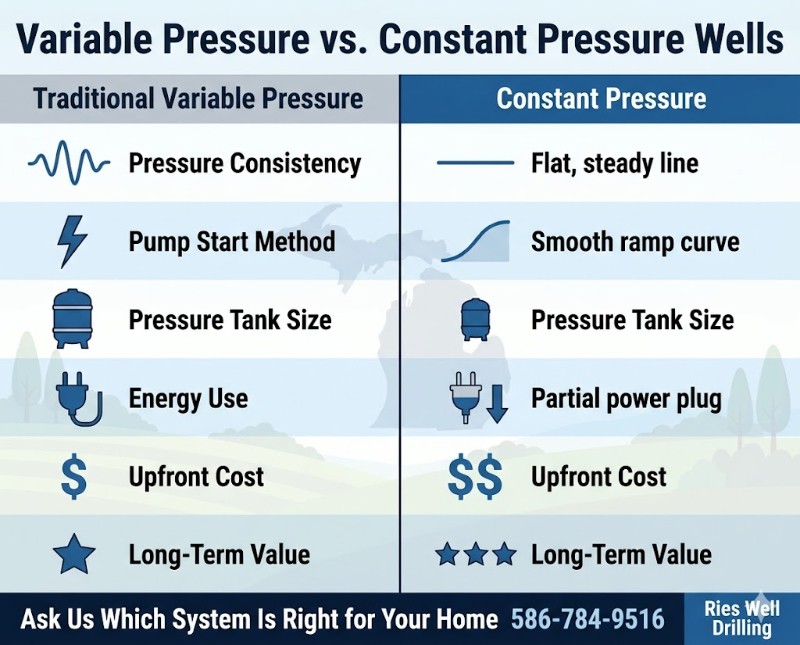
Water pressure consistency. Traditional: pressure varies between cut-in and cutoff points throughout the day, and drops during high-demand periods. Constant pressure: pressure stays at setpoint regardless of demand. Winner: constant pressure.
Pump longevity. Traditional: pump starts hard, with a current surge every cycle. Multiple hard starts per day over years of operation is significant wear. Constant pressure: pump ramps up and down smoothly with no hard starts. Winner: constant pressure.
Pressure tank size. Traditional: requires a large pressure tank to provide adequate drawdown between pump cycles. Constant pressure: the VFD controller directly manages demand, so a small tank is sufficient. Winner: constant pressure for mechanical room space.
Initial cost. Traditional: lower upfront cost for a comparable pump replacement. Constant pressure: higher upfront cost due to the VFD controller. Winner: traditional for initial outlay. However, the gap is smaller when comparing a full system replacement (pump, new pressure tank, and switch) vs. a constant-pressure system.
Energy efficiency. Traditional: pump runs at full speed every cycle regardless of demand. Constant pressure: pump speed matches demand — lower speed means lower energy draw. Winner: constant pressure, especially for high-demand households.
Maintenance. Traditional: pressure tank bladder replacement is a common service call. Short-cycling from a waterlogged tank is hard on pumps. Constant pressure: pressure tank failure mode is eliminated. Winner: constant pressure for lower ongoing maintenance.
WHICH SYSTEM IS RIGHT FOR YOUR HOME?
For most Richmond and Lenox Township homeowners evaluating a pump or system replacement, the case for constant pressure is strong — particularly if:
Your household has multiple bathrooms and multiple simultaneous users.
You have an irrigation system that noticeably lowers the pressure inside the house when it runs.
Your current pump is aging, and you’re already facing replacement costs.
You’ve been frustrated by inconsistent pressure and want a meaningful improvement.
For a household with very modest water demand — one or two people, minimal simultaneous fixture use — a traditional system replacement may be a perfectly adequate and more economical choice. There’s no universally right answer; it depends on how your household uses water and what budget makes sense for your situation.
WHAT ABOUT YOUR EXISTING WELL?
One thing to clarify: switching to constant pressure doesn’t require drilling a new well. The upgrade involves the pump, controller, and pressure tank components. If your existing well is in good structural condition and producing adequate water, it’s the platform for either system type.
If your existing well has problems — reduced yield, casing damage, aging components — those should be addressed as part of the assessment regardless of which pressure system you choose.
SCHEDULE A SYSTEM ASSESSMENT
The best way to know which option makes sense for your specific home is a conversation with Ries Well Drilling. They’ll assess your current system, ask about your household’s water use patterns, and give you a clear comparison of your options — including honest guidance on what they think makes sense for your situation.
Call Ries Well Drilling at 586-784-9516. They serve Richmond, Lenox Township, Ray Township, Armada Township, and communities throughout Macomb, Oakland, Lapeer, and St. Clair Counties.