
Bruce Township is one of Macomb County’s most rural communities, and that’s a big part of what draws people to it. Wide lots, quiet roads, room for horses and gardens, and a pace of life that feels a long way from the suburban sprawl pushing northward from Detroit. But that same rurality means one very practical reality: most homes in Bruce Township run on private wells. Municipal water service is limited or nonexistent across much of the township, so if you’re buying land, building a new home, or purchasing an older property out here, understanding how private water systems work isn’t optional — it’s essential.
Ries Well Drilling has been serving Bruce Township and the rural communities of Macomb County since 1983. Here’s what every Bruce Township homeowner should know about well drilling before they break ground or sign a purchase agreement.
IS THERE CITY WATER AVAILABLE ON YOUR PROPERTY?
Before assuming you need a well, verify whether municipal water service is available at your specific parcel. In Bruce Township, availability varies street by street in some areas. Contact the township or Macomb County to confirm. If water main extension is technically possible but would require you to pay for a connection that runs hundreds of feet, a private well may actually be more cost-effective even where service technically exists.
For most rural parcels in Bruce Township — particularly those along Wolcott, Powell, Fairchild, and similar roads away from the western edge of the township — a private well is simply the way water is done.
HOW DOES THE WELL DRILLING PROCESS WORK?
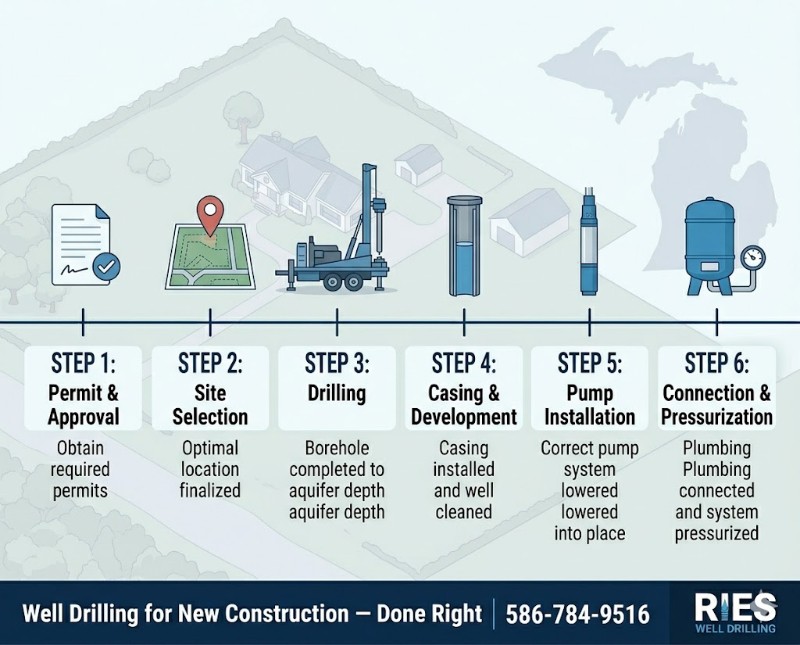
Once you’ve confirmed a well is needed, the process follows a defined sequence that Ries Well Drilling manages from start to finish.
Step one is the permit. In Macomb County, the Health Department must approve well placement before drilling begins. The permit application requires property information and typically involves a review of setback requirements — how far the well must be from the septic system, property lines, and other potential sources of contamination. Ries handles this paperwork on your behalf.
Step two is site selection. Where the well is located on your property matters. Michigan setback requirements dictate minimum distances from the septic field, the home’s foundation, and any potential contamination sources. An experienced driller will help you choose a location that meets all regulatory requirements and is practical for your water line routing.
Step three is drilling. A rotary drilling rig is brought to the site and begins boring through the soil layers until it reaches a suitable water-bearing formation. In Bruce Township and much of northern Macomb County, drillers typically expect to go somewhere between 80 and 200 feet, though local geology can push that deeper. The driller logs everything as they go — soil composition, water-bearing zones, depth at which water is encountered — and this information becomes part of your permanent well record.
Step four is casing and development. Steel casing is driven into the borehole to protect the well from surface contamination and cave-in. The well is then developed — water is pumped and tested to clear drilling debris and assess the well’s production rate.
Step five is pump installation. The submersible pump, drop pipe, and wiring are lowered into the well. The pump is sized to match your expected household demand and the well’s production capacity.
Step six is connection. A pitless adapter allows the water line to exit the well casing below the frost line. The line is then buried and run to your pressure tank inside the home, where a pressure switch and tank work together to maintain consistent water pressure.
HOW LONG DOES IT TAKE?
For a new residential well in Bruce Township under normal conditions, the drilling and pump installation can typically be completed in one to two days once permits are in hand. Permit processing through Macomb County Health Department adds time to the front end of the project, so it’s smart to initiate the process early — particularly if you’re working against a construction schedule.
WHAT ABOUT OLDER WELLS ON EXISTING PROPERTIES?
If you’re purchasing an older home in Bruce Township that already has a well, don’t assume it’s in good working order just because water comes out of the tap. Older wells should be inspected and tested before or shortly after purchase. Key factors to evaluate include the age and condition of the pump, the condition of the pressure tank, the integrity of the well cap and casing, and water quality.
Many older homes in Bruce Township, Armada Township, Ray Township, and Lenox Township have wells that were drilled decades ago. They may have functioned reliably for years, but aging components — particularly pumps and pressure tanks — can fail without much warning. A well inspection from Ries Well Drilling can give you a clear picture of what you’re working with and what maintenance or upgrades may be needed.
WHAT SHOULD YOU TEST FOR IN YOUR WELL WATER?
Private well owners in Michigan are responsible for their own water testing. In Bruce Township’s agricultural environment, water quality considerations include not just the standard bacteria and nitrate tests but also potential pesticide and herbicide runoff from nearby farmland. Michigan recommends annual testing at minimum for coliform bacteria, E. coli, and nitrates.
Your water should be tested by a state-certified laboratory. Ries Well Drilling can advise you on appropriate testing for your specific area.
PLANNING A NEW BUILD IN BRUCE TOWNSHIP?
If you’re planning new construction, get your well scheduled early in the process. You’ll need water on site before many other construction tasks can proceed, and permitting takes time. Don’t wait until you’re ready to frame the house to start thinking about the well.
To get started, call Ries Well Drilling at 586-784-9516. They serve Bruce Township, Armada Township, Washington Township, Ray Township, and communities throughout Macomb, Oakland, Lapeer, and St. Clair Counties.