
Low water pressure is one of the most frustrating home problems to live with. It makes showers weak, fills washing machines slowly, and turns simple tasks like rinsing dishes into an exercise in patience. And if you’re a Ray Township homeowner on a private well, low pressure is something your neighbors are probably familiar with too — because in one of Macomb County’s most rural townships, almost every home is running on a private water system.
The important thing to understand about low water pressure on a well system is that “low pressure” is a symptom, not a diagnosis. There are multiple things that can cause it, and the right fix depends entirely on which one is actually the problem. Some causes are simple and inexpensive. Others require more significant work. And some what-seems-like-a-pressure-problem situations actually turn out to be a plumbing issue inside the house that has nothing to do with the well at all.
Ries Well Drilling has been diagnosing and repairing well systems in Ray Township and throughout Macomb County since 1983. Here’s a breakdown of the most common reasons Ray Township homeowners experience low water pressure — and what each one means for your repair options.
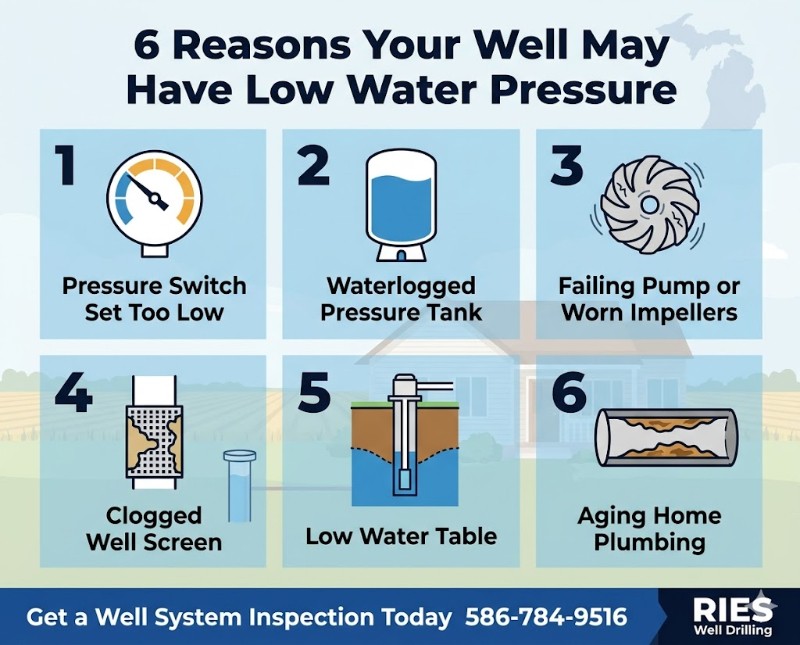
CAUSE 1: PRESSURE SWITCH SET TOO LOW
Your pressure switch controls the on/off operation of your well pump by responding to system pressure levels. A standard residential pressure switch is often set to a “cut-in” pressure of 30 PSI (when the pump turns on) and a “cut-out” pressure of 50 PSI (when it shuts off). This is sometimes noted as a 30/50 setting.
Some homes have older pressure switches set at 20/40, which delivers noticeably lower pressure at fixtures — particularly on the second floor or at the far end of the house from the pressure tank. Upgrading to a 40/60 setting can make a meaningful difference in the pressure you feel at the tap, as long as your system components can handle the higher pressure range.
This is one of the simpler adjustments a well service technician can make, but it should be done carefully — pushing pressure too high can stress pipes, fittings, and the pump itself.
CAUSE 2: WATERLOGGED PRESSURE TANK
The pressure tank in your basement or utility room has an important job: it holds a reserve of pressurized water so your pump doesn’t have to run every single time you open a faucet. Inside the tank is an air bladder or diaphragm that separates the air charge from the water. When the bladder fails, water fills the entire tank and the air cushion disappears.
A waterlogged tank doesn’t hold pressure the way it should, which means the pump runs constantly and pressure fluctuates more than it should. You may notice the pump clicking on very frequently — sometimes with every glass of water you draw — and pressure that seems to rise and fall rather than staying steady.
The fix is pressure tank replacement. For most Ray Township homes, this is a repair that can be completed in a few hours. A properly sized replacement tank, matched to your household’s water demand, makes a noticeable difference in both pressure consistency and pump longevity.
CAUSE 3: FAILING PUMP OR WORN IMPELLERS
Inside your submersible well pump are impellers — rotating components that move water up the drop pipe to your home. Over time, impellers wear down and their efficiency decreases. A pump with worn impellers can still move water, but it can’t maintain the pressure it once did. The result is progressively lower system pressure that declines gradually enough that you might not notice it happening — until you compare your current pressure to what it used to be.
If your pump is more than 10 years old and your pressure has been gradually declining, the pump itself may be the issue. A well service inspection can assess pump performance and help you make an informed decision about whether to repair or replace.
CAUSE 4: CLOGGED WELL SCREEN OR INTAKE
The well screen at the bottom of your pump intake prevents sand and debris from entering the pump. Over time, the screen can become partially clogged with mineral deposits, iron ochre, or fine sediment, restricting the amount of water the pump can draw in and reducing system pressure.
A severely clogged intake can also cause the pump to run hot, shortening its lifespan. In some cases, well rehabilitation — cleaning and treatment of the well bore and pump components — can restore performance without full replacement.
CAUSE 5: LOW WATER TABLE OR REDUCED WELL YIELD
During dry periods, the water table in parts of Ray Township and neighboring rural communities in Macomb County can drop. If your pump intake is near the lower end of the water column and the water table falls, the pump may begin pulling air intermittently, resulting in sputtering water and reduced pressure — particularly during high-demand periods like morning showers or irrigation.
This situation is more common in dug or shallow wells than in drilled wells that reach deep aquifers, but it’s worth knowing about if you’re experiencing pressure issues during dry summer months.
CAUSE 6: PLUMBING ISSUES INSIDE THE HOME
Not every low-pressure complaint is actually a well problem. Older galvanized steel pipes common in homes built in the 1950s through 1980s can corrode internally over decades, narrowing the diameter through which water can flow. This creates resistance and pressure loss that worsen over time and are sometimes mistakenly attributed to the well system.
A good diagnostic approach is to check the pressure at the pressure tank itself. If pressure at the tank is normal but pressure at fixtures is low, the problem is more likely downstream in the home’s plumbing rather than in the well system.
GETTING A DIAGNOSIS
The most reliable way to identify the cause of your low pressure is to have your well system inspected. A trained technician will check system pressure at the tank, assess pump cycling behavior, test the pressure tank pre-charge, inspect electrical components, and review the overall system performance.
Call Ries Well Drilling at 586-784-9516 to schedule a well system inspection. They serve Ray Township, Armada Township, Lenox Township, Bruce Township, and communities throughout Macomb, Oakland, Lapeer, and St. Clair Counties.