
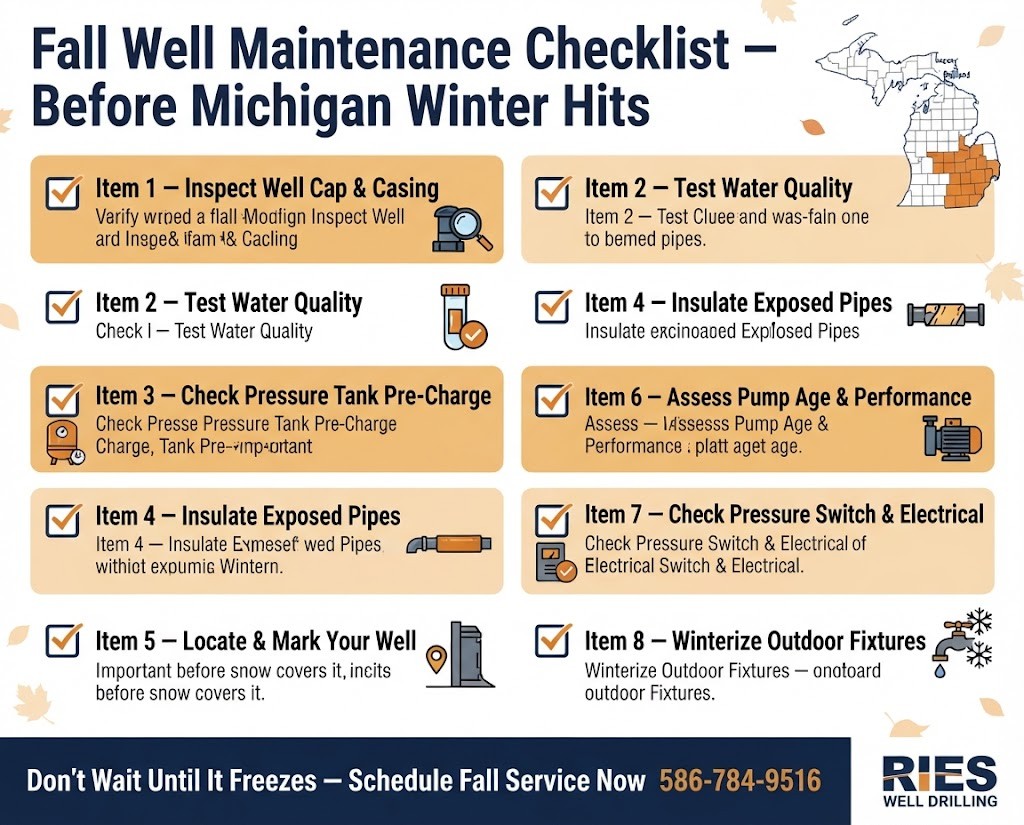
Michigan doesn’t ease into winter. One week you’re running the irrigation system; the next you’re watching the forecast for the first hard freeze. For homeowners on private wells throughout Macomb, Oakland, Lapeer, and St. Clair Counties, that seasonal transition carries a specific set of to-dos that city water customers never have to think about.
Your well system faces Michigan’s full range of conditions — brutal winters, wet springs, dry summers, and freeze-thaw cycles that are especially hard on plumbing and mechanical components. A few hours of attention in September or October can prevent failures that leave you without water in January, when getting a service truck to your property is harder and the consequences are worse.
Ries Well Drilling has been keeping Southeast Michigan well systems running through decades of Michigan winters. Here’s the fall maintenance checklist they recommend for private well owners throughout the region.
1. INSPECT YOUR WELL CAP AND CASING
The well cap is the first line of defense between your water supply and everything above ground — insects, small animals, surface runoff, and debris. Walk out to your well casing and take a close look. The cap should fit snugly with no visible cracks, gaps, or damage. The cap’s vents should be screened and intact. If the cap is loose, cracked, or missing its screen, replace it before winter.
While you’re at the casing, look at the upper portion above ground. At least 12 inches of casing should be above the final grade. If soil, mulch, or landscaping has accumulated around the base of the casing over the years, make sure it hasn’t buried or compromised the casing’s protective function.
One practical note specific to Michigan winters: mark your well casing location before the first significant snowfall. A stake or marker near the casing prevents snowblowers, plows, and vehicles from contacting it during winter—a more common source of casing damage than most homeowners realize.
2. TEST YOUR WATER QUALITY
Fall is an ideal time for annual water quality testing. Michigan recommends that private well owners test at least annually for coliform bacteria, E. coli, and nitrates. Testing in the fall gives you results before the ground freezes, when follow-up action — if contamination is found — is easier to address.
For homeowners in Macomb County’s agricultural townships (Armada, Bruce, Ray, Lenox), Lapeer County, and rural St. Clair County, nitrate testing is particularly important given the proximity of crop farming and fertilizer application. Fall, after the growing season, is a relevant time to capture any seasonal contamination from agricultural runoff.
If you haven’t tested for iron, hardness, or pH recently — particularly if you’ve noticed staining, scale buildup, or changes in taste or smell — add those parameters to this year’s test.
3. CHECK YOUR PRESSURE TANK PRE-CHARGE
Your pressure tank has a Schrader valve — similar to a tire valve — on its side. With the pump off and system pressure bled down, you can check the tank’s air pre-charge with a standard tire pressure gauge. Set the pre-charge about 2 PSI below your pump’s cut-in pressure. For a 30/50 system, that means 28 PSI; for a 40/60 system, 38 PSI.
A pre-charge that reads zero indicates a failed bladder. A pre-charge significantly lower than it should be may indicate a slow leak. Either situation warrants attention — a failed bladder leads to short-cycling, which is hard on your pump motor and will shorten pump life if not addressed.
If you’re not comfortable checking this yourself, it’s a straightforward item for a well service technician during a fall inspection visit.
4. ASSESS PUMP AGE AND PERFORMANCE
If you know your pump’s installation date, fall is a good time to factor that into your planning. A pump approaching 15 years old isn’t guaranteed to fail, but statistically it’s in the zone where failures become more likely. A proactive replacement on your schedule — before winter, when scheduling is flexible and conditions are workable — is far preferable to an emergency replacement in January.
Performance indicators worth paying attention to: Has pressure at fixtures changed noticeably from prior seasons? Does the pump seem to run longer than it used to? Have you noticed the pump cycling more frequently? Any of these can indicate declining pump efficiency worth investigating before the cold sets in.
5. INSULATE EXPOSED PIPES AND WELL COMPONENTS
In most properly installed residential wells in Southeast Michigan, the water line exits the casing below the frost line via a pitless adapter and travels underground to the home — protected from freezing by depth. But exposed plumbing in unheated spaces (crawl spaces, unheated garages, outbuildings) and any above-ground components associated with the well can freeze.
Foam pipe insulation is inexpensive and easy to install on exposed pipes. Heat tape is an option for pipes that are particularly exposed to cold air infiltration. If your pressure tank is in an unheated space, consider whether that space will stay above freezing during a cold snap—even a brief period of severe cold can freeze and burst a pressure tank in an unprotected location.
6. WINTERIZE OUTDOOR WATER FIXTURES
Outdoor hose bibs, irrigation systems, and any water lines that run to outbuildings or animal watering stations need to be properly winterized before the first hard freeze. This means shutting off the interior supply valve to each outdoor fixture, disconnecting and draining hoses, and allowing the exterior portion of the fixture to drain completely.
For irrigation systems connected to well water, blowing out lines with compressed air is the most thorough winterization approach. Water left in irrigation lines and sprinkler heads will freeze and expand, cracking components that can be expensive to repair come spring.
7. CHECK ELECTRICAL COMPONENTS
Visually inspect the electrical system that powers your well pump—the wiring, disconnect box, pressure switch, and connections—for signs of corrosion, rodent damage, or loose connections. Fall is when field mice begin looking for warm places to nest, and electrical boxes near well components are a known target.
If you notice any burnt smell, corrosion on terminals, or evidence of rodent activity in or around your electrical components, call for service before winter. An electrical fault in the well pump circuit is a problem you don’t want to discover in February.
8. SCHEDULE A PROFESSIONAL WELL INSPECTION IF YOU’RE OVERDUE
If your well system hasn’t had a professional inspection in five or more years — or if you’ve never had one since moving into your home — fall is the ideal time to schedule it. Before the ground freezes, conditions are optimal for a full system assessment: pump performance testing, pressure tank evaluation, electrical inspection, water level check, and casing and cap condition review.
A professional well inspection costs a small fraction of emergency service and component replacement if a problem is caught too late.
SCHEDULE YOUR FALL WELL SERVICE
Ries Well Drilling serves homeowners throughout Macomb County (Washington Township, Armada, Bruce, Ray, Lenox, Shelby, Macomb Township, Chesterfield), Oakland County (Oxford, Addison, Brandon, Oakland Township), Lapeer County (Metamora, Hadley, Dryden), and St. Clair County (Clay, Cottrellville, China, Ira Township). Call them at 586-784-9516 to schedule your fall well inspection before the season gets away from you.