
St. Clair County is often called Michigan’s Blue Water County, and the name fits. Between the St. Clair River, Lake St. Clair, and the miles of shoreline and waterfront communities along the county’s eastern edge, water is very much part of the identity here. But for the tens of thousands of residents who live in the county’s rural townships — Clay Township, Cottrellville Township, China Township, Ira Township, Riley Township, and others — the water they count on every day comes not from the lake but from the ground.
Private wells are the norm across much of rural St. Clair County. And as those wells age and pump systems come up for replacement, more homeowners are choosing to upgrade from traditional pressure systems to constant pressure — and finding that the performance improvement is worth it.
Ries Well Drilling serves St. Clair County homeowners, as well as clients in Macomb, Oakland, and Lapeer counties. Here’s an honest assessment of whether a constant pressure system is right for your St. Clair County home.
FIRST, WHAT’S WRONG WITH A TRADITIONAL WELL SYSTEM?
Nothing — if it’s sized and maintained properly, a conventional pressure system can serve a household reliably for decades. But there are specific limitations that homeowners on traditional systems learn to live with, and most of them trace back to the fundamental design: a pump that runs at full speed until the system hits cutoff pressure, then shuts off.
The consequence of this design is variable pressure. Your pressure when the tank is full is different from your pressure when the tank is almost empty and waiting for the pump to cycle on. Under normal single-fixture use, the variation isn’t dramatic. But in a busy household with multiple bathrooms, a large irrigation system, or high simultaneous water demand, the pressure swings become more noticeable.
St. Clair County’s rural residential housing stock includes many older homes — built in the 1960s through 1980s — with well systems originally designed for lower household water demand than families typically use today. A system that worked fine for a family of three in 1975 may struggle to meet the water demands of a modern family or a renovated home with multiple full baths.
WHAT DOES CONSTANT PRESSURE ACTUALLY CHANGE?
The core technology in a modern constant-pressure system is a variable-frequency drive (VFD), also called a variable-speed drive, that sits between the electrical service and the pump motor. Instead of the motor running at one speed — full — the drive adjusts motor speed in real time to match demand.
The practical result is that system pressure stays at a set point — typically 60 PSI — regardless of demand. One faucet running, the pump runs slowly. Three showers and the dishwasher running simultaneously, the pump speeds up to meet the load. The pressure at every fixture stays essentially constant.
Ries Well Drilling installs Franklin Electric SubDrive systems, a proven residential constant pressure solution.
WHAT ARE THE REAL-WORLD BENEFITS FOR ST. CLAIR COUNTY HOMEOWNERS?
Consistent pressure is the headline benefit, but it’s not the only one worth discussing.
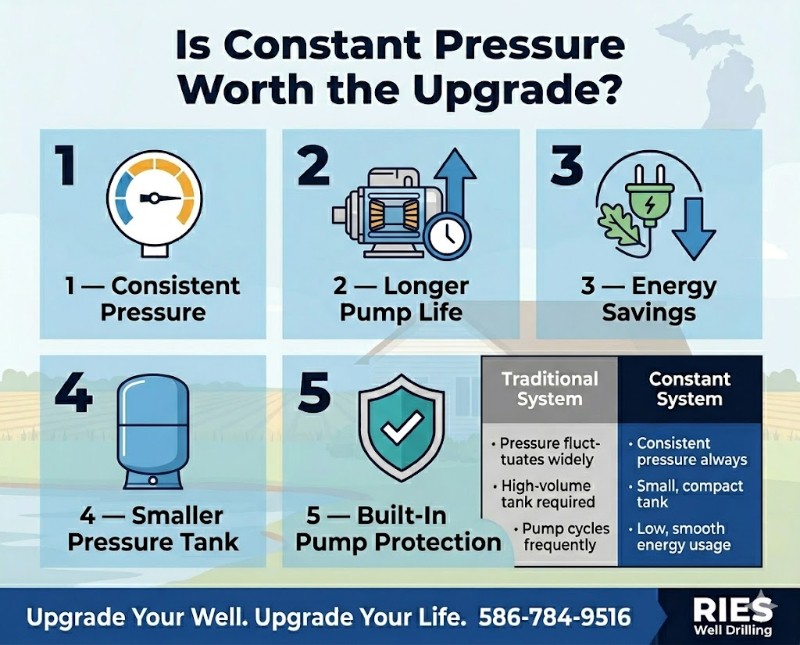
Extended pump life. Traditional pumps start hard — a surge of current every time the motor kicks on. Variable speed drives eliminate hard starts by ramping the motor up smoothly. This is considerably less wear on the motor windings and bearings over time.
Energy savings. A pump running at 60% speed to meet moderate demand uses substantially less power than a pump running at full speed and cycling on and off. For households with significant water use, the energy difference adds up.
Reduced pressure tank size. With constant pressure management handled by the controller, the pressure tank’s role becomes minimal — just a small buffer for system stability. This can simplify equipment room layout and reduce the cost of pressure tank components.
Waterlogged tank problems become irrelevant. One of the most common well service calls — a waterlogged pressure tank causing short-cycling — is essentially eliminated with constant pressure because the system doesn’t rely on a large pressurized tank to buffer demand.
Protection features. Modern constant-pressure systems include protection against low-water conditions (the system senses reduced pump load and shuts down before the pump runs dry), motor overtemperature, and other faults that can damage conventional pumps.
WHAT DOES THE UPGRADE COST AND HOW DOES IT COMPARE TO A TRADITIONAL PUMP REPLACEMENT?
The honest answer is that a constant pressure system costs more upfront than a standard pump replacement. The variable speed drive controller, compatible pump, and installation represent a higher initial investment.
However, the comparison should be against a full traditional system replacement — new pump, new pressure tank, new pressure switch — not just a pump alone. When you compare total system replacement costs, the gap narrows considerably. And when you factor in the extended pump life, energy savings, and elimination of future pressure tank-related service calls, many homeowners find the value calculation clearly favors constant pressure.
The best scenario for an upgrade is when your current pump is at or near the end of its life anyway. At that point, you’re making a replacement decision regardless — the question is simply what to replace it with.
IS YOUR CURRENT WELL A GOOD CANDIDATE?
Not every existing well is an ideal candidate for a constant pressure retrofit. Well depth, casing diameter, current pump size, and electrical service capacity all factor into whether a straightforward retrofit is practical or modifications are needed.
Ries Well Drilling will assess your St. Clair County property and give you a clear-eyed recommendation — including an honest answer if a traditional replacement makes more sense for your specific situation.
Call Ries Well Drilling at 586-784-9516. They serve Clay Township, Cottrellville Township, China Township, Ira Township, Riley Township, and communities throughout St. Clair, Macomb, Oakland, and Lapeer Counties.