
Lenox Township and the City of Richmond sit in the northeastern corner of Macomb County, where suburban development gives way to the open fields, farm properties, and semi-rural residential parcels that define this part of Michigan. If you’re building a new home in this area — or purchasing land with the intention of building — there’s a reasonable chance your property won’t have access to municipal water service. That means a private well is on your project list, whether you’ve thought about it yet or not.
For many new home builders, the well is an afterthought — something to deal with when the time comes. That mindset consistently creates problems. Wells require permits that take time to process, and the drilling itself needs to happen at a specific point in the construction sequence. Getting that timing wrong can stall your entire project.
Ries Well Drilling has drilled new construction wells throughout Lenox Township, Richmond, Armada Township, Ray Township, and northeastern Macomb County for over four decades. Here’s everything first-time well owners building in this area need to know.
FIRST: CONFIRM WHETHER A WELL IS ACTUALLY NEEDED
Before assuming you need a private well, verify whether municipal water service is available at your specific parcel. In Lenox Township and the Richmond area, availability varies — the City of Richmond has municipal water within its boundaries, but coverage drops off quickly in the surrounding township. Contact Macomb County or the township directly to confirm what’s available at your address or parcel number.
For most rural parcels in Lenox Township — particularly those on agricultural road frontages away from the city boundaries — a private well is the only option. Confirm this before purchase if you haven’t already.
START THE PERMITTING PROCESS EARLIER THAN YOU THINK YOU NEED TO
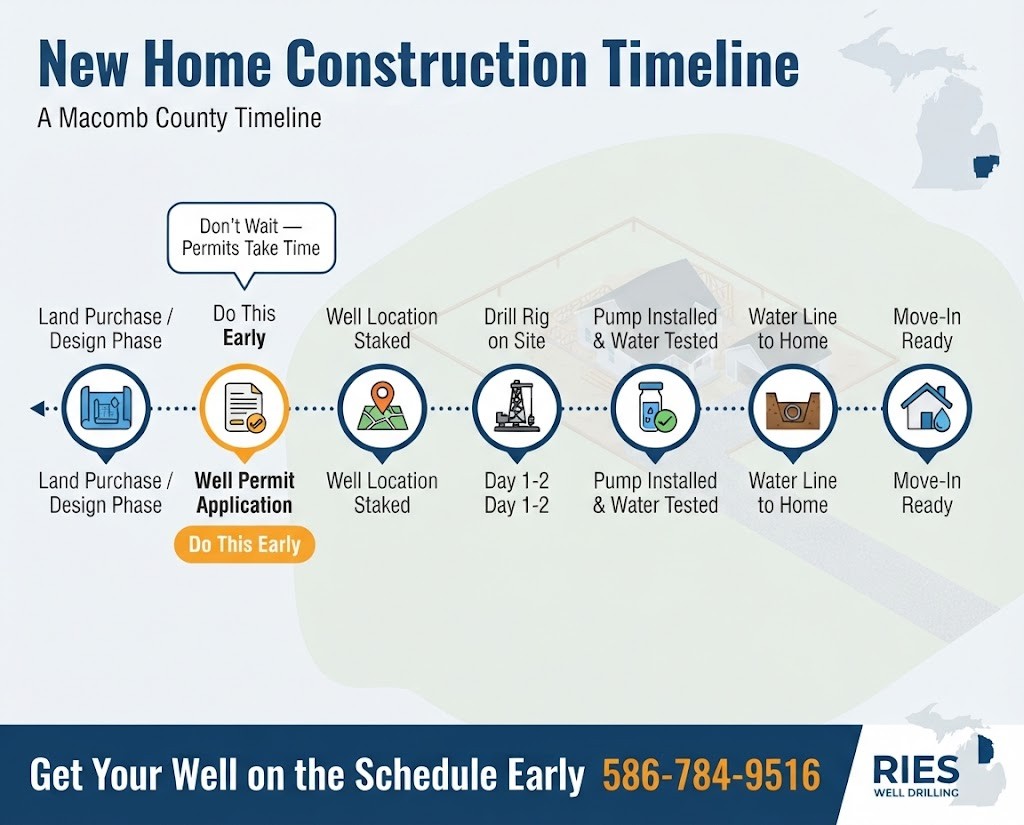
This is the single most important piece of advice Ries Well Drilling gives to new construction clients: start the well permit application process as early as possible. In Macomb County, the Macomb County Health Department issues well installation permits, and the process includes property review, setback compliance verification, and approval of the proposed well location.
Between submitting the permit application and receiving approval, you can be looking at several weeks—potentially longer during peak construction season in spring and early summer. If you’re working against a construction timeline with subcontractors scheduled and a target move-in date, a permit delay can cascade into significant project disruption.
Ries Well Drilling handles the permit application for you. But they need time, so the conversation should start in the design phase—before you break ground, before you pour your foundation, and before you commit to a site plan that may need to be adjusted based on well placement requirements.
HOW WELL LOCATION INTERACTS WITH YOUR SITE PLAN
Michigan’s Well Construction and Pump Installation Code specifies minimum setback distances between a well and other features on your property. The well must be a minimum distance from your septic system (drainfield and tank), the home’s foundation, property lines, fuel storage, and other potential contamination sources.
On a rural Lenox Township parcel, coordinating the well location with your septic system layout is the most critical planning interaction. Both systems need to comply with setback requirements relative to each other, and neither can be placed in a way that forces the other into a non-compliant or impractical location.
The ideal approach: involve your well driller and septic contractor in the site-planning conversation before either system is permitted or installed. Ries Well Drilling regularly coordinates with septic contractors during the planning phase to ensure both systems end up in workable locations. Getting this right on paper before anything is in the ground is far easier than trying to work around a septic field that was placed without considering well setbacks.
WHEN IN THE CONSTRUCTION SEQUENCE DOES THE WELL GET DRILLED?
For most new home builds in Lenox Township and Richmond, the well is drilled early in the construction process — typically after the foundation is complete but before framing is well underway. Here’s why timing matters:
You need water on site for construction. Concrete work, masonry, and, in some jurisdictions, certain inspections require water access. Getting the well operational early provides a water source for the construction process itself.
Coordinate the water line with other underground work. The buried supply line from the well to the home runs underground and needs to be coordinated with other utility trenching, the foundation drainage system, and landscaping plans. Doing this excavation after the home is nearly complete is significantly more disruptive and expensive.
Inspectors may require a functioning well before certain milestones. Depending on the sequence your local inspector uses, you may need a working water supply before certain inspections or before a certificate of occupancy is issued.
WHAT YOUR COMPLETE WELL SYSTEM WILL INCLUDE
A new construction well installation in Lenox Township or Richmond includes all of the components that make up a functioning residential water system:
- The drilled bore hole, reaching the depth required to access a productive, clean water source. In northeastern Macomb County, depths typically range from 80 to 180 feet depending on location and local geology.
- Steel casing and grouted annular seal protecting the well bore from surface contamination and structural collapse.
- A submersible pump sized to your household’s expected water demand — number of bathrooms, irrigation plans, and any additional water uses should all inform pump selection.
- Drop pipe, wiring, and pitless adapter connecting the pump to the surface and the buried water line.
- Pressure tank and pressure switch, installed in your basement or mechanical room, to regulate system pressure and protect the pump.
- The buried water line from the well to your home’s plumbing system.
This is also a good time to consider whether a constant pressure system makes sense for your new home. If you’re building a home with multiple bathrooms, an irrigation system, or significant water demand, a variable-speed constant-pressure pump system—rather than a traditional fixed-speed pump—will deliver noticeably better pressure consistency and longer pump life. The incremental cost at new construction is much lower than retrofitting an existing system later.
WATER TESTING BEFORE YOU MOVE IN
Before your family drinks the water from a newly drilled well, test it. A new well is tested during the development process to confirm production yield, but water quality testing is a separate step. At minimum, test for coliform bacteria, E. coli, and nitrates. In agricultural areas of Lenox Township where crop farming is prevalent, nitrate testing is particularly important.
Your lender may require a water test as a condition of the mortgage on a new build with a private well. Even if they don’t, get it done before you move in.
GET STARTED WITH Ries Well Drilling
If you’re building in Lenox Township, Richmond, Ray Township, Armada Township, or anywhere in northeastern Macomb County and need a well, call now—before your construction timeline is set in stone. Ries Well Drilling will assess your parcel, initiate permitting, and schedule drilling to fit your construction sequence.
Call 586-784-9516 to get started. Ries Well Drilling serves Lenox Township, Richmond, Ray Township, Armada Township, and communities throughout Macomb, Oakland, Lapeer, and St. Clair Counties.