
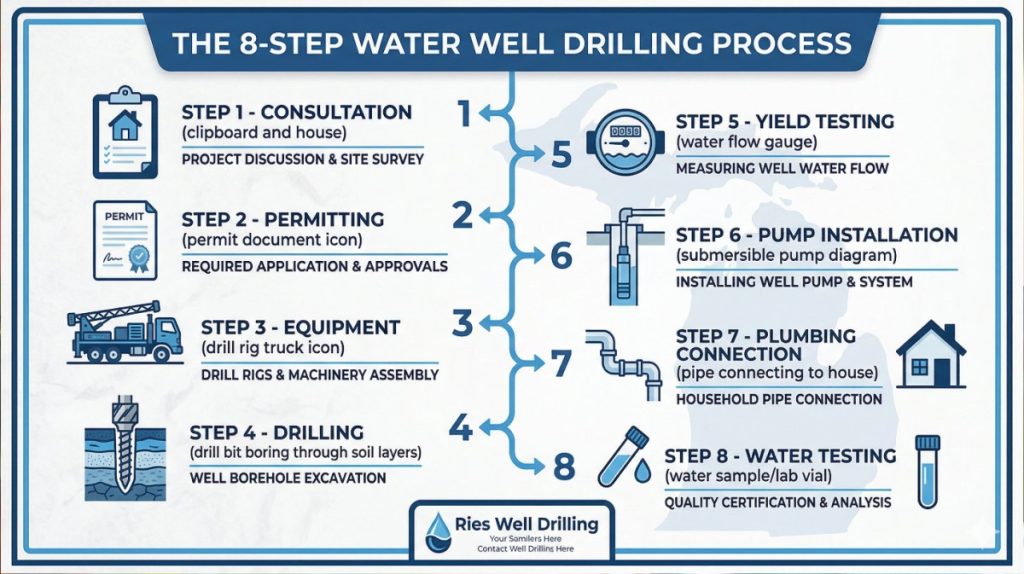
For most homeowners in Armada Township, Bruce Township, Ray Township, and the rural corners of Macomb County, a water well is one of the most important systems on their property — and one of the least understood. When a new well is needed, whether for a new construction home, a replacement on an aging system, or a second well for irrigation, the process can feel unfamiliar and a little intimidating.
It doesn’t have to be. At Ries Well Drilling, we’ve been walking Southeast Michigan homeowners through this process since 1983. Here’s exactly what happens from start to finish when you hire us to drill a new water well.
Step 1: Initial Consultation and Site Evaluation
Before any drilling begins, we meet with you to assess your property and understand your water needs. This conversation covers several things:
- What will the well be used for — household drinking water, irrigation, livestock, or a combination?
- Where is your existing septic system, if you have one? Michigan regulations require specific setback distances between wells and septic components.
- Are there any buried utilities, structures, or easements that affect where the well can be located?
- What’s the water history in your area? In many parts of Macomb County, we have decades of experience with local aquifer depths and yield — that local knowledge speeds up the process.
Based on this evaluation, we identify the best location on your property for the new well and give you a clear estimate for the project.
Step 2: Permitting
A new well in Michigan requires a well construction permit from your county health department. This is a non-negotiable requirement — and any contractor who suggests skipping it is a red flag.
For homeowners in Macomb County, the permit is filed through the Macomb County Health Department. Oakland, St. Clair, and Lapeer Counties each have their own processes. We handle the permit application on your behalf and coordinate with the health department throughout the project. We also arrange any required inspections.
Permitting timelines vary by county and time of year. In some cases, it takes a few days; during busy spring and summer seasons, it can take longer. We’ll give you a realistic timeline upfront so there are no surprises.
Step 3: Mobilizing the Equipment
Once the permit is in hand, we schedule the drilling. Our truck-mounted rotary drill rig is set up at the agreed-upon location on your property. We take care to minimize impact on your lawn and landscaping — though we do need a clear access path wide enough for the rig to reach the drill site.
We also bring everything needed to complete the project in a single visit whenever possible: casing pipe, pump components, pressure tank, fittings, and all associated materials. We don’t like making unnecessary return trips any more than you do.
Step 4: Drilling
This is the part most homeowners are curious about. Rotary well drilling uses a rotating drill bit and a combination of water and drill mud to bore through the earth and remove cuttings from the hole. As drilling progresses, steel or PVC casing is installed to line the borehole and prevent collapse.
In much of Macomb County, productive water-bearing zones are found at depths of roughly 60 to 120 feet, though this varies significantly by location. Washington Township tends to have geology different from that of Chesterfield Township or the townships closer to the St. Clair County border. Our experience in this area gives us a good sense of what to expect underground before the bit ever touches the soil.
Drilling typically takes most of a day for a standard residential well. Harder rock formations, deeper aquifers, or challenging site conditions can extend that timeline.
Step 5: Development and Yield Testing
After drilling reaches the target depth and the casing is set, we develop the well — a process that clears drilling debris from the borehole and allows the surrounding formation to stabilize. We then conduct a basic yield test to confirm the well is producing adequate water for your needs.
Michigan requires a minimum yield of one gallon per minute for a residential well. Most wells we drill in Macomb County significantly exceed that threshold, but it’s important to verify before proceeding to pump installation.
Step 6: Pump and Pressure System Installation
With the well confirmed and developed, we install the complete water delivery system:
- Submersible pump: sized to your household’s water demand and the depth of your well
- Drop pipe and electrical wiring: runs from the pump up through the casing to the surface
- Wellhead and sanitary well cap: seals the top of the casing against insects, surface water, and contaminants
- Pressure tank: installed inside the home or in a utility space, stores pressurized water and regulates pump cycling
- Pressure switch and gauge: controls when the pump activates and monitors system pressure
If you’re interested in a constant-pressure system — which delivers steady water pressure regardless of how many fixtures are running simultaneously — this is the time to discuss it. We’ll explain the benefits and costs so you can make an informed decision.
Step 7: Connection to Your Home’s Plumbing
Once the pump and tank are installed, we connect the well to your home’s existing plumbing. This involves running the supply line from the wellhead into the house and tying it into your water distribution system. If you’re replacing an old well with a new one, we also properly decommission the old well per Michigan EGLE requirements — sealing the casing with bentonite grout to prevent it from becoming a conduit for surface contamination into the groundwater.
Step 8: Water Testing
We strongly recommend — and some counties require — a water quality test before the new well is placed into regular use. Standard panel tests for coliform bacteria and E. coli, which can be introduced during drilling, should be flushed out through a chlorination process. We can also arrange testing for nitrates, arsenic, iron, hardness, and other parameters relevant to your area.
Test samples are sent to a state-certified laboratory, and results typically return within 5 to 14 days. We walk you through the results and explain what they mean for your household.
What Does a New Well Cost in Michigan?
Drilling costs vary based on depth, soil conditions, the selected pump and pressure system, and any site-specific challenges. We provide detailed written estimates before any work begins so you know exactly what you’re committing to. There are no surprises on our invoices.
We also gladly accept insurance work—if your well has been damaged by lightning, flooding, or another covered event, we can work with your insurance company directly.
Serving Southeast Michigan Since 1983
From Armada Township to Macomb Township, from the rural roads of Lapeer County to the lakefront communities along St. Clair County, Ries Well Drilling has been the family-owned well contractor Southeast Michigan homeowners trust for more than four decades.
Ready to get started? Call us at 586-784-9516 or visit rieswelldrilling.com to request your free estimate. We’re licensed, fully insured, and proud members of the Better Business Bureau, the National Groundwater Association, and the Michigan Ground Water Association.
📞 Call Ries Well Drilling at (586) 784-9516 and set the foundation for a smooth and efficient well-drilling process. Ensure that your water well project is not just a plan but a work in progress poised for success.
Visit Ries Well Drilling for more information and to take the first step towards securing your water future in Michigan. Don’t wait for the rush; start your well-drilling journey today!
Contact Ries Well Drilling Inc. for all your water well drilling needs in: