
If you’re buying a home in Macomb, Oakland, St. Clair, or Lapeer County that relies on a private well, getting a professional well inspection is one of the smartest things you can do before closing. And if you already own a home with a well, regular inspections keep your water safe and your system running at its best.
But what exactly does a well inspection cover — and what are inspectors actually looking for? Here’s a straightforward guide from the team at Ries Well Drilling, your local Southeast Michigan well experts since 1983.
Why Well Inspections Matter in Southeast Michigan
Unlike municipal water systems, private wells are the homeowner’s sole responsibility. There’s no utility company monitoring your water quality or your pump performance. That responsibility falls entirely on you, which makes professional inspections essential.
In Southeast Michigan, groundwater quality varies significantly by county and even by township. Areas of Lapeer County, for example, have documented elevated levels of arsenic, nitrates, and chlorides in certain groundwater zones. St. Clair County has pockets near industrial activity where contamination risk is higher. Without testing and inspection, you simply don’t know what’s in your water.
What a Professional Well Inspection Covers
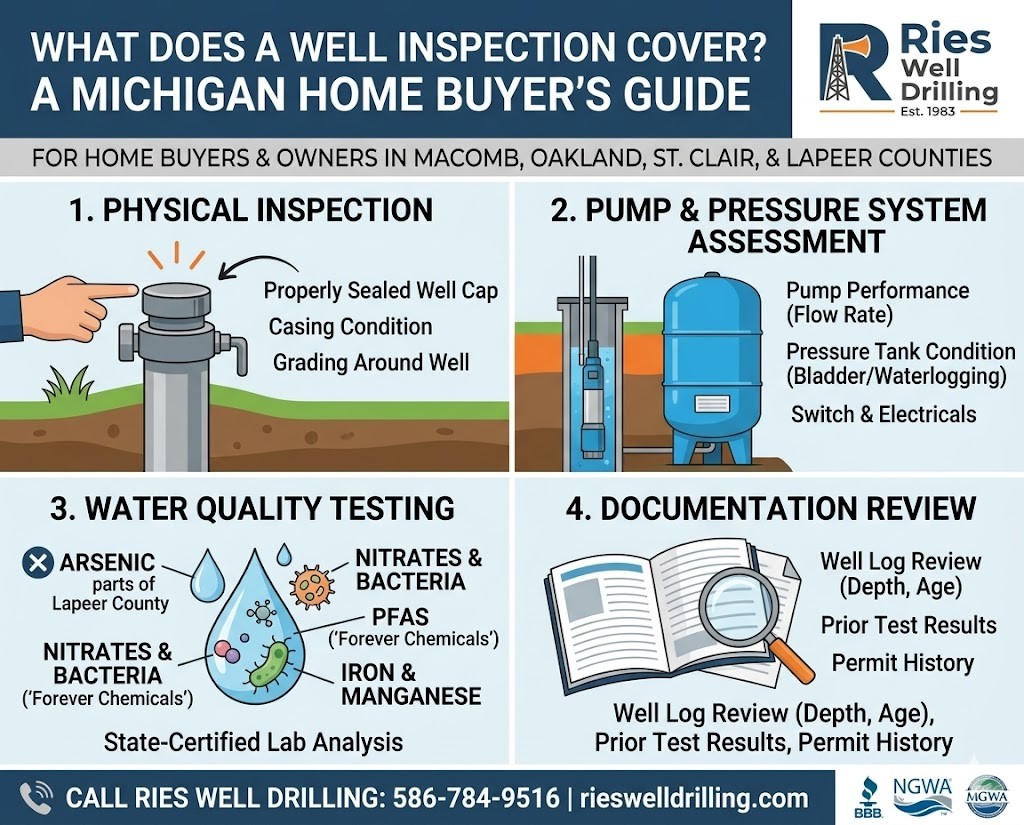
1. Physical Inspection of the Wellhead and Casing
The wellhead is the portion of the well that sits above ground. Inspectors look for:
- A properly sealed and secured well cap — loose or damaged caps allow insects, surface water, and contaminants to enter the well
- Casing condition — cracks, corrosion, or improper depth can compromise water quality
- Proper grading around the wellhead — the ground should slope away from the well to prevent surface runoff from pooling near the casing
- Isolation distances — Michigan code requires minimum separation between wells and septic systems, fuel tanks, and other contamination sources
2. Pump and Pressure System Assessment
The pump and pressure tank are the mechanical heart of your water system. An inspection evaluates:
- Pump performance — flow rate, pressure, and whether the system meets household demand
- Pressure tank condition — waterlogged tanks and failed bladders are common in older systems
- Pressure switch settings and function
- Control box wiring and electrical connections
- Age and estimated remaining service life of components
3. Water Quality Testing
A full well inspection typically includes water sampling. At a minimum, Michigan health guidance recommends testing for coliform bacteria, E. coli, nitrates, and nitrites. Depending on the property’s history and location, additional tests may be recommended for:
- Arsenic (elevated in parts of Lapeer County)
- Iron and manganese (common throughout Southeast Michigan)
- PFAS — so-called ‘forever chemicals’ that are a documented concern across Michigan
- Hardness, chlorides, and sulfates
Water samples are sent to a state-certified laboratory. Results are typically returned within a few days to two weeks depending on the tests ordered.
4. Documentation and Records Review
A thorough inspection includes a review of available well records — including the original well log (if filed with Michigan EGLE), any prior water test results, and permit history. Well logs document the depth, casing specifications, and drilling date, which helps assess the well’s current condition and remaining lifespan.
Well Inspections for Home Buyers: What You Need to Know
If you’re purchasing a home with a private well, here are the key points:
- A standard home inspection does not typically include a well inspection. You’ll need to hire a licensed well contractor separately.
- In Michigan, water tests are required when a well is constructed or repaired — but not at the point of sale. That means many wells change hands without any current water quality data.
- Mortgage lenders — especially FHA and USDA loans — often require a well inspection and satisfactory water test before approving financing for rural properties.
- Problems found during inspection can be used as negotiating leverage with the seller or may be required to be remediated before closing.
How Often Should You Get a Well Inspection?
The Michigan Department of Health and Human Services recommends annual water testing for private well owners. A full mechanical inspection every 3–5 years is a good benchmark for most well systems, with more frequent service if:
• You notice changes in water taste, color, or odor
• Water pressure has decreased noticeably
• Your pump is more than 10 years old
• There has been flooding, a nearby chemical spill, or agricultural activity near your well
• A household member is pregnant, or a baby is living in the home
What Happens If Problems Are Found?
Not every inspection turns up problems — but when it does, the good news is that most issues are fixable. Common findings include worn pump components requiring replacement, pressure tanks nearing the end of their life, wellhead sealing issues, or water quality concerns that can be addressed with treatment systems.
At Ries Well Drilling, we walk you through every finding, explain your options clearly, and provide upfront pricing before any work begins. There are no surprises.
Ready to Schedule Service with Ries Well Drilling?
Since 1983, Ries Well Drilling has been the family-owned well company Southeast Michigan homeowners trust. We serve Macomb, Oakland, St. Clair, and Lapeer Counties with prompt, professional, and fully licensed well services.
Call us today at 586-784-9516 or visit rieswelldrilling.com to request your free estimate. We’re proud members of the Better Business Bureau, the National Groundwater Association, and the Michigan Ground Water Association — and we gladly accept insurance work.