
If your home in Washington Township, Macomb Township, or Shelby Charter Township is on city water, the municipality tests and treats your water regularly and reports the results publicly. But if you’re on a private well — like roughly 40 percent of Michigan households — that responsibility falls entirely on you.
Most private well owners know they should test their water. Far fewer actually do it, and even fewer do so on the schedule recommended by health experts. At Ries Well Drilling, we’ve been serving well owners across Macomb, Oakland, St. Clair, and Lapeer Counties since 1983, and water quality testing is one of the most important conversations we have with homeowners. Here’s what you need to know.
Why Private Well Owners Are Responsible for Their Own Testing
The federal Safe Drinking Water Act regulates public water systems — but private wells serving fewer than 25 people are explicitly exempt. That means no government agency is routinely monitoring the water coming out of your tap. The Michigan Department of Health and Human Services (MDHHS) recommends annual testing, but it’s a recommendation, not a requirement enforced by regular inspections.
The practical implication: if your well water has a problem, you may not know it unless you test. Many contaminants — including bacteria, nitrates, arsenic, and radon — are colorless, odorless, and tasteless at the concentrations at which they cause health effects. Waiting for your water to look or smell wrong before testing is not a reliable safety strategy.
How Often Should You Test Your Well Water?
The MDHHS recommends testing private well water at a minimum once per year for bacteria (total coliform and E. coli). Beyond that annual baseline, additional testing is recommended in the following circumstances:
- After any work on the well — drilling, pump replacement, pressure tank service, or wellhead repair
- Following flooding, heavy rainfall, or snowmelt events that could have introduced surface water near the wellhead
- If you notice any change in taste, odor, color, or clarity of your water
- If a household member experiences unexplained gastrointestinal illness
- After purchasing a home with a private well, regardless of when it was last tested
- If any potential contamination source is identified near your well — fuel spills, pesticide application, septic issues
Spring is an especially good time to conduct your annual test, because snowmelt and saturated soils can temporarily elevate bacteria levels in shallow groundwater — which is why we include water testing in our spring maintenance conversations with homeowners throughout Armada Township, Ray Township, and the surrounding communities.
What Should You Test For?
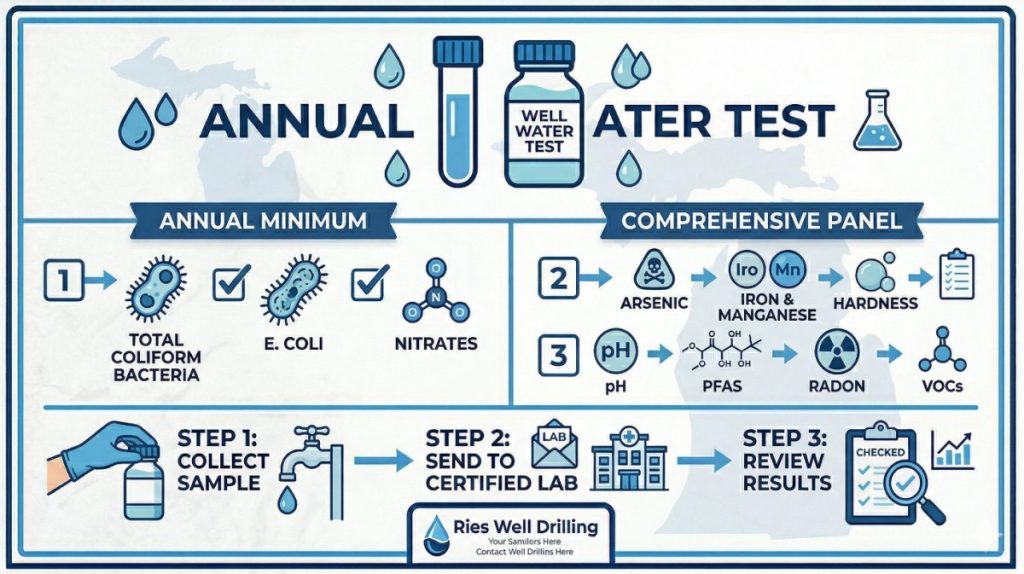
At a minimum, an annual test should cover:
- Total coliform bacteria: the standard indicator of whether your water has been contaminated by surface runoff, animal waste, or septic issues
- coli: indicates fecal contamination specifically and represents a more serious health concern
- Nitrates: a concern especially for households with infants, as high nitrate levels can cause a condition affecting blood oxygen in babies
For a more complete picture of your water quality — particularly if you’ve never had a comprehensive test or have moved into a home with an existing well — consider adding:
- Arsenic: naturally occurring in some Michigan groundwater, particularly in parts of Lapeer and Oakland Counties. There is no safe level of long-term arsenic exposure.
- Iron and manganese: extremely common in Southeast Michigan well water. High levels cause staining, taste issues, and can affect water-using appliances, but they also have health implications at elevated concentrations.
- Hardness: Michigan groundwater is typically very hard. Understanding your hardness level helps you decide whether a water softener makes sense.
- pH: acidic water corrodes pipes and plumbing fixtures; alkaline water can cause scale buildup. Either extreme can be addressed once you know where you stand.
- PFAS (per- and polyfluoroalkyl substances): increasingly a concern across Michigan, including in parts of Macomb and St. Clair Counties. We covered PFAS in detail in a previous blog post.
- Radon: a radioactive gas that can dissolve into groundwater and be released into indoor air during water use. Michigan has areas with elevated radon in bedrock.
- Volatile organic compounds (VOCs): relevant if your well is in or near an industrial area, along transportation corridors, or near historically contaminated sites.
How Is Well Water Tested?
Water testing for private wells involves collecting samples according to specific protocols and sending them to a certified laboratory. The sampling method matters — bacteria tests in particular require a sterile collection technique to avoid false positives from contamination of the sample container itself.
Options for getting your water tested in Macomb County and the surrounding area include:
- Your county health department: Macomb, Oakland, St. Clair, and Lapeer County health departments can provide guidance on certified labs and, in some cases, collect samples directly
- Through Ries Well Drilling, we can coordinate water sampling as part of a service visit or annual inspection
- State-certified private laboratories: several operate in Southeast Michigan and accept mailed samples for most standard parameters
Bacteria tests typically return results in 24 to 48 hours. Comprehensive chemical panels can take 5 to 14 days. Results are provided in a laboratory report that lists each parameter tested, the detected concentration, and the applicable health-based standard for comparison.
What Do You Do If Your Water Test Comes Back With a Problem?
Don’t panic — but don’t ignore it either. A positive bacteria test, for example, is relatively common and can result from contamination of the sample itself, a problem with the wellhead, a cracked casing, or a compromised seal. The right response depends on what the test found and how your system is configured.
We walk homeowners through their test results and recommend appropriate next steps. These might include:
- Shock chlorination to disinfect the well and plumbing system (a common first response to a bacteria-positive)
- Wellhead inspection and repair to eliminate the contamination pathway
- Treatment system installation for persistent chemical issues like iron, hardness, or arsenic
- Re-testing to confirm whether the issue was a sampling anomaly or a genuine ongoing problem
- In serious cases, the evaluation of whether the well can be rehabilitated or needs replacement
Testing When Buying or Selling a Home with a Well
If you’re purchasing a home in Lenox Township, Richmond Township, or anywhere else in our service area that has a private well, require a water quality test as part of your due diligence — not just a well inspection. A well can pass a structural inspection and still have water quality issues that are invisible without testing.
For sellers, having a current, clean water test on file is a selling point. It demonstrates that the well has been maintained, giving buyers confidence. We can arrange pre-listing water testing and provide documentation suitable for real estate transactions.
Your Water. Your Responsibility. Let Us Help.
Private well ownership comes with real responsibilities — but it also offers the benefit of independence from municipal water systems, and in most of Southeast Michigan, well water can be maintained at a high quality with the right attention.
If you’re not sure when your water was last tested, now is a good time to schedule a test. Call Ries Well Drilling at 586-784-9516 or visit rieswelldrilling.com to get started. We serve Macomb, Oakland, St. Clair, and Lapeer Counties and have been keeping Southeast Michigan’s well water safe since 1983.
📞 Call Ries Well Drilling at (586) 784-9516 and set the foundation for a smooth and efficient well-drilling process. Ensure that your water well project is not just a plan but a work in progress poised for success.
Visit Ries Well Drilling for more information and to take the first step towards securing your water future in Michigan. Don’t wait for the rush; start your well-drilling journey today!
Contact Ries Well Drilling Inc. for all your water well drilling needs in: