
Nothing gets your attention faster than turning on a faucet and getting nothing. For homeowners in Macomb, Oakland, St. Clair, and Lapeer Counties who rely on a private well, a pump failure means no water for drinking, cooking, bathing, or flushing — and it always seems to happen at the worst possible time.
Before you panic, there are a few simple things you can check yourself. But knowing when to stop troubleshooting and call a licensed well contractor can save you from making the problem worse — or more expensive.
Start Here: Quick Checks Before You Call
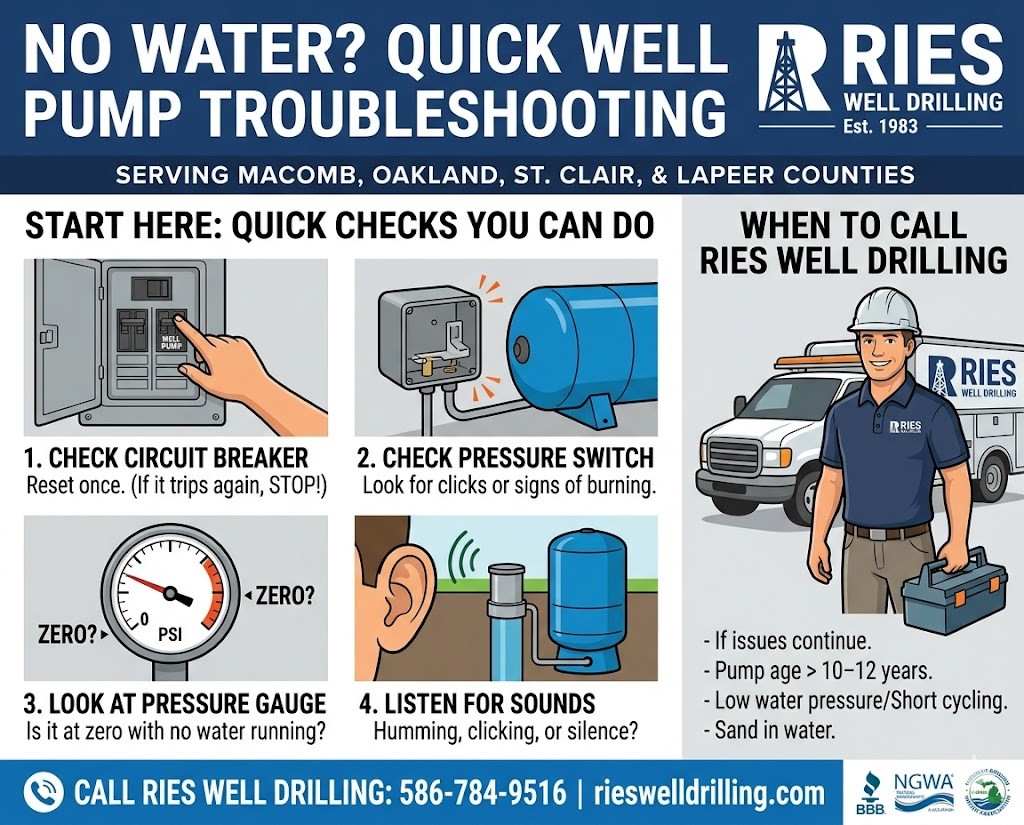
Some well pump issues are not actually pump problems. Before assuming the worst, run through this quick checklist:
- Check your circuit breaker. Well pumps run on dedicated circuits. A tripped breaker is one of the most common causes of sudden water loss. Reset it once, but if it trips again immediately, stop. Repeated trips usually indicate a deeper electrical or mechanical issue.
- Check your pressure switch. Located near the pressure tank, the pressure switch can sometimes stick or fail. It should click on and off as pressure cycles. If it’s not clicking or shows signs of burning, that’s a warning sign.
- Look at your pressure gauge. A gauge reading zero when no water is running points to a pump or pressure tank issue. A gauge that won’t move at all may indicate a stuck switch or a waterlogged tank.
- Listen for unusual sounds. Clicking relays, humming motors, or total silence when the pump should be running all tell different stories about what’s wrong.
Common Well Pump Problems in Southeast Michigan
Michigan homeowners face specific well conditions. The glacial soils and aquifer depths across Macomb, Oakland, St. Clair, and Lapeer Counties can affect how pumps age and fail. Here are the most common issues we see:
Worn-Out Pump Motor
Submersible pumps sit at the bottom of your well, often 100–400 feet below ground. They’re built to last 10–15 years, but mineral-rich groundwater — common in Southeast Michigan — can accelerate wear. When the motor fails, the pump simply stops delivering water.
Pressure Tank Failure
Your pressure tank maintains steady water pressure between pump cycles. When the internal bladder fails, the pump has to work overtime — running constantly or cycling on and off rapidly (called ‘short cycling’). This burns out the pump motor prematurely and spikes your electricity bill.
Low or Dry Well
Extended dry periods can lower the water table enough to starve a well pump. If your pump is running but producing little or no water — especially during summer droughts — the water level in your well may have dropped below the pump intake. This is a situation that needs professional assessment.
Broken Well Pipe or Fitting
The drop pipe that connects your pump to the surface can crack, disconnect, or corrode over time. Water simply circulates back into the well instead of reaching your home. This can be tricky to diagnose without proper equipment.
Electrical Faults
Wiring inside the well or at the control box can corrode, short out, or become damaged by pests. Electrical issues in well systems should never be diagnosed or repaired by anyone other than a licensed professional.
Signs Your Well Pump Needs Replacing (Not Just Repairing)
Sometimes a repair is the right answer. Other times, replacement is the smarter long-term investment. Here’s how to tell the difference:
- Your pump is more than 10–12 years old and has failed once before
- Repair costs exceed 50% of the replacement cost
- You’re experiencing frequent pressure fluctuations or short cycling
- Your water contains sand or sediment — a sign that the pump intake is damaged or the well itself is deteriorating
- You’re upgrading to a constant-pressure system for better whole-home water flow
Don’t Delay — Here’s Why Prompt Repair Matters
A pump that’s struggling — short-cycling, running constantly, or delivering weak pressure — is on its way to complete failure. Running a compromised pump stresses the motor and can turn a manageable repair into a full pump-and-tank replacement.
In winter, a drop in water pressure can also signal a risk of freezing in exposed components, especially in rural areas of Lapeer County and northern Macomb County, where pipes may run through uninsulated spaces.
The bottom line: if your well pump is showing signs of trouble, early service is almost always less expensive than emergency replacement.
What to Expect From a Professional Well Pump Service Call
When you call Ries Well Drilling, a licensed technician will:
- Assess your pressure tank, pressure switch, and control box
- Test pump performance at the wellhead
- Pull the pump if necessary to inspect the motor, check valve, and drop pipe
- Provide a clear diagnosis and upfront estimate before any work begins
- Handle all required permitting if a new well or major component is needed
We carry parts on our trucks and can handle most repairs and replacements in a single visit.
Ready to Schedule Service with Ries Well Drilling?
Since 1983, Ries Well Drilling has been the family-owned well company Southeast Michigan homeowners trust. We serve Macomb, Oakland, St. Clair, and Lapeer Counties with prompt, professional, and fully licensed well services.
Call us today at 586-784-9516 or visit rieswelldrilling.com to request your free estimate. We’re proud members of the Better Business Bureau, the National Groundwater Association, and the Michigan Ground Water Association — and we gladly accept insurance work.