
If you own a home in Washington Township, Armada, Bruce Township, or anywhere else in Macomb County that relies on a private well, you’ve probably wondered at some point: how long is this well going to last? It’s a fair question — and one that doesn’t have a simple answer. The lifespan of a water well depends on several factors, from the geology of the ground beneath your property to how well the system has been maintained over the years.
At Ries Well Drilling, we’ve been drilling and servicing wells across Macomb, Oakland, St. Clair, and Lapeer Counties since 1983. In that time, we’ve seen wells that were still performing strongly at 40 years old and others that needed replacement in under 15 years. Here’s what homeowners should know about well lifespan—and the signs it may be time to call us.
How Long Does a Water Well Typically Last?
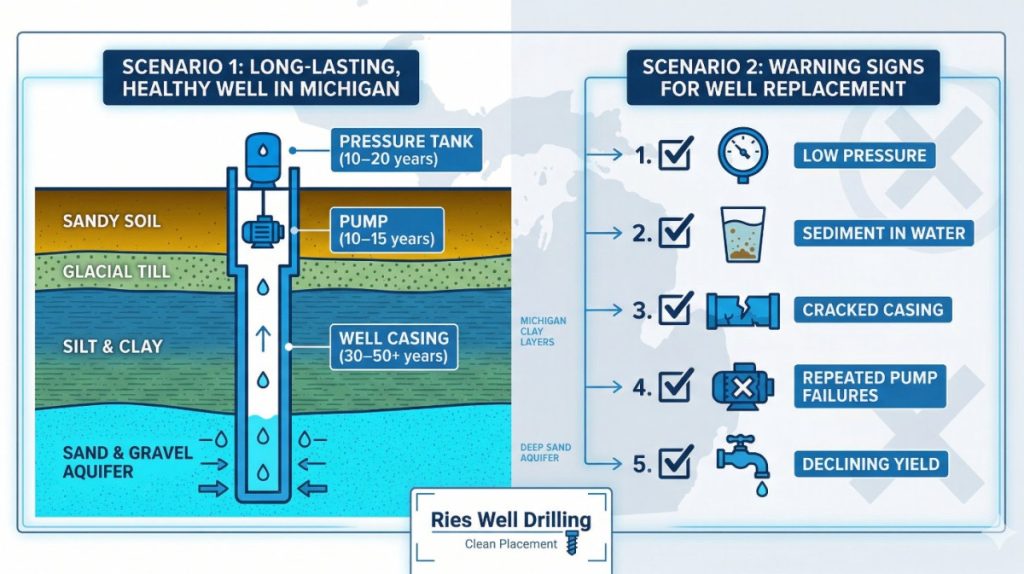
A properly drilled, cased, and maintained well can last anywhere from 20 to 50 years or more. The well itself — meaning the borehole and the casing — often outlasts the mechanical components inside it. What tends to fail first are the pump, the pressure tank, and the wellhead components. Those have shorter lifecycles:
- Submersible pumps: 10–15 years on average
- Pressure tanks: 10–20 years, depending on water quality and maintenance
- Wellhead components and seals: 20–30+ years with proper care
- Well casing (steel or PVC): 30–50+ years in most conditions
That said, Michigan’s geology varies significantly from township to township. Sandy soils in parts of Lapeer County and the clay-heavy areas throughout Macomb County can affect how wells age and how sediment moves through the system. Local groundwater chemistry — particularly iron content, hardness, and pH — also affects how quickly internal components corrode or scale.
What Affects Well Lifespan?
1. Construction Quality
A well drilled by a licensed, experienced contractor with the right casing depth, grouting, and cap installation will simply last longer than one drilled by a contractor cutting corners. This is one of the reasons homeowners in Ray Township, Lenox Township, and Shelby Charter Township rely on established local contractors — the quality of the original installation matters enormously over the decades.
2. Water Chemistry
Michigan groundwater tends to be hard, with elevated iron and manganese in many areas. Highly acidic water can corrode steel casing and pump components faster than neutral water. If your well has never been tested for water chemistry and you’ve had repeated pump failures, chemistry may be a contributing factor.
3. Maintenance History
Wells that receive annual inspections, water testing, and prompt attention to early problems consistently outlast wells that are ignored until something breaks. A well that’s had the same pump running for 20 years without a single inspection is an unpredictable system — even if it’s still producing water today.
4. Groundwater Changes
In some parts of Southeast Michigan, water table levels have shifted over the years due to development, agricultural use, and climate patterns. A well drilled in the 1970s may now be drawing from a lower, dirtier water table than it was designed for. This can affect yield, water quality, and the workload placed on the pump.
Warning Signs Your Well May Need to Be Replaced
Not every problem means you need a new well — but some warning signs are worth taking seriously. Here’s what to watch for in homes across Macomb Township, Chesterfield Township, Richmond Township, and the surrounding communities:
- Consistently low water pressure that doesn’t improve after pump service
- Decreased yield — the well runs dry or slows dramatically during periods of higher use
- Persistent sand or sediment in your water
- A well that requires repeated pump replacements in a short period
- Deteriorating or cracked casing that can no longer be sealed
- Water quality has significantly declined and cannot be addressed through treatment
- A well that’s approaching 40+ years old with no major service history
In some of these cases, the solution is a new well drilled nearby rather than attempts to rehabilitate an aging borehole. Our team can evaluate your existing system and give you an honest assessment of whether repair or replacement makes more sense.
What Does the Well Replacement Process Look Like?
If your well does need to be replaced, here’s a general overview of what to expect when you work with Ries Well Drilling:
Site Assessment
We begin with an evaluation of your property — reviewing the location of the existing well, septic system, structures, and property lines. Setback requirements under Michigan regulations dictate where a new well can be sited. In most cases, on Macomb County residential properties, a suitable location is available.
Permitting
A new well requires a well construction permit from your county health department. We handle the paperwork and coordinate with local officials to ensure the project remains compliant. Macomb County has specific permit requirements, and we’re well-versed in navigating that process after more than 40 years of working in this region.
Drilling
We use rotary drilling methods with PVC well casing. The depth of the new well is determined by the local aquifer — in many parts of Macomb County, productive water-bearing zones are found between 60 and 120 feet, though this varies by location. We drill until we reach a reliable water-bearing formation and establish the appropriate yield.
Pump Installation and Connection
Once the well is drilled and cased, we install a new submersible pump, pressure tank, and all necessary plumbing connections. The old well is properly decommissioned and abandoned per Michigan EGLE requirements — a critical step that’s sometimes skipped by less thorough contractors.
Water Testing
We recommend testing the new well before it goes into regular use. This establishes a baseline for water quality and ensures that no contamination was introduced during drilling.
Repair vs. Replace: How to Know Which Is Right
This is the most common question we hear from homeowners in Harrison Township, Clinton Township, and throughout our service area. The honest answer depends on the specific condition of your existing system. As a general rule:
- If your pump or pressure tank has failed but the well itself is structurally sound and producing good-quality water, repair or component replacement is usually the right call.
- If the casing is deteriorating, the yield has dropped significantly, or the well has had repeated issues over several years, replacement is likely the better long-term investment.
- If you’re buying a home with an older well of unknown service history, get an inspection before closing — not after.
We’ll always give you a straight answer. If your well has life left in it, we’ll tell you. And if replacement is the smarter choice for your household and your budget over the long run, we’ll explain why.
Ready to Talk About Your Well?
Whether your well is showing warning signs or you simply want to know where you stand, Ries Well Drilling is here to help. We’ve been serving homeowners throughout Macomb, Oakland, St. Clair, and Lapeer Counties since 1983 — and we’re proud members of the Better Business Bureau, the National Groundwater Association, and the Michigan Ground Water Association.
Call us today at 586-784-9516 or visit rieswelldrilling.com to request your free estimate. We gladly accept insurance work.
📞 Call Ries Well Drilling at (586) 784-9516 and set the foundation for a smooth and efficient well-drilling process. Ensure that your water well project is not just a plan but a work in progress poised for success.
Visit Ries Well Drilling for more information and to take the first step towards securing your water future in Michigan. Don’t wait for the rush; start your well-drilling journey today!
Contact Ries Well Drilling Inc. for all your water well drilling needs in: