
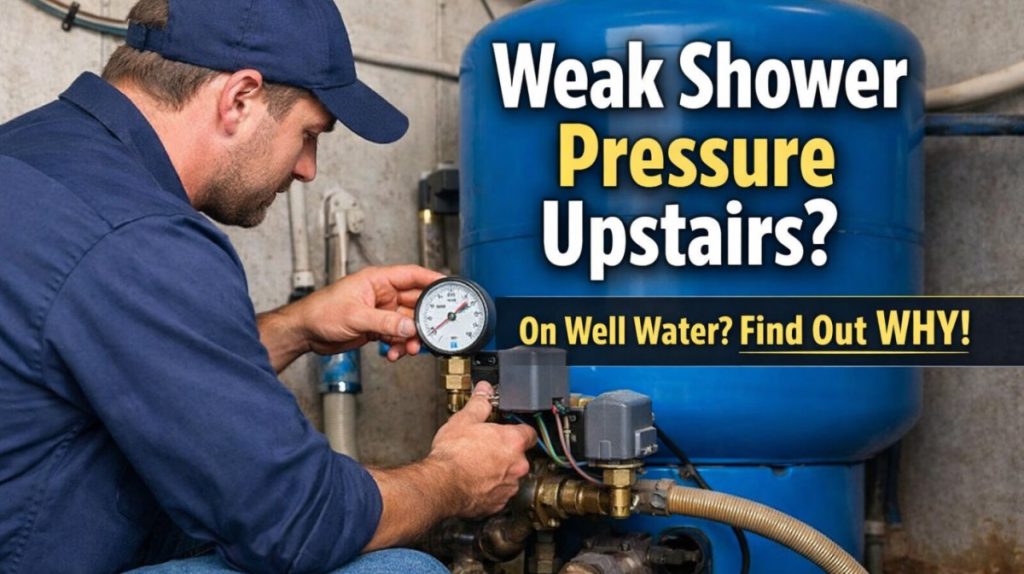
If your upstairs shower pressure is weak on well water, you’re not imagining it — and it doesn’t automatically mean you need a new well. A lot of homeowners notice the same pattern: the shower starts fine, then someone turns on a faucet, the dishwasher kicks on, or the washing machine begins filling… and the shower drops, sputters, or turns into a trickle.
In Macomb, Oakland, St. Clair, and Lapeer County homes, that usually comes down to a handful of causes: normal pressure loss to the second floor, a conventional system that naturally fluctuates, a pressure tank issue, or a pump/control problem that needs attention.
In this guide, we’ll break down what’s most likely happening, what you can check quickly, and when a constant pressure system (like a Franklin Electric SubDrive) is the right upgrade. Ries Well Drilling has served Southeast Michigan since 1983 — call 586-784-9516 for a FREE estimate.
Why is the upstairs shower pressure worse on well water?
If the pressure in an upstairs shower drops on well water, it is usually not caused by mysterious plumbing. Most often, it’s simply that first-floor living spaces tend to experience pressure or flow issues when running multiple fixtures simultaneously; here are four potential causes we usually come across:
- Normal friction loss + height: Water must travel farther to reach a second-floor shower, forcing upward against pipe runs, elbows, and elevation before it is brought up the stairs for use. Long pipe runs, elbows, and elevation all reduce pressure naturally first in this direction.
- Pressure fluctuations in a conventional well system (20 lb fluctuation): Unfortunately, not all standard systems provide perfectly even pressure; when someone turns on another faucet or shower head, normal volatility may cause the pressure in that room to temporarily drop significantly, creating noticeable shower pressure fluctuations.
- Pressure Tank Bladder Issue: If the bladder in a pressure tank fails, pressure can become inconsistent, frequently switching on and off — leading to weak or “surgy” upstairs flow.
- Pump/Control Problem (Pump Not Shutting Off): If your pump runs continuously without stopping, resulting in inconsistent pressure levels, this may indicate an underlying system issue that requires further investigation.
If you live in Macomb, Oakland, St. Clair, or Lapeer counties and would like a FREE estimate, contact us at 586-784-9516 now!
How a typical well water pressure system works (and why pressure fluctuates)
Southeast Michigan well systems typically operate with a simple on/off cycle: water is delivered from a submersible pump at the bottom of your well to your home through its water line, where it feeds a pressure tank with either an air charge or a bladder that compresses as water enters it, helping your system provide usable pressure as soon as you open a faucet.
A pressure switch controls the entire cycle. When pressure in the system drops below its “cut-in” number (for instance, when starting up your shower), this tells the pump to switch on until system pressure reaches “cut-out”, at which point it turns off again, water then coming from the tank until pressure decreases again and the cycle repeats itself.
Here’s the critical point: conventional setups don’t keep pressure at a single number. They generally operate within a range that may seem like pressure “fluctuations,” particularly when multiple fixtures are used at once. When someone turns on another faucet, demand increases, and pressure may dip before its capacity has caught up to meet demand.
Showers on the second floor often display this issue first due to two opposing forces at work: height (water has to travel up) and friction loss (pressure is lost through pipe length, fittings, and restrictions). As such, they often feel weak even though their downstairs counterpart appears normal.
Now let’s address some of the more likely causes.
Step-by-step: what causes weak pressure upstairs (and how to tell which one you have)
Before jumping to conclusions, take the time to observe when pressure in the home drops significantly and what else may be occurring at the same time. Doing this could point you in the direction of potential causes – and help save you from replacing parts unnecessary for operation.
1) Friction loss + elevation (the “normal” reason for higher altitudes may not apply as strongly).
In a two-story home, an upstairs shower will often be the first place you notice a pressure issue because water has to travel further and higher than usual. Every foot of vertical rise and every extra section of pipe adds resistance, and elbows, valves, showerheads, and long runs contribute to “friction loss,” reducing both flow rate and pressure by the time water reaches your showerhead.
What to Pay Attention to:
- Do the sinks and showers on the main floor have adequate pressure, while only upstairs feel low?
- Does it worsen during high-demand times such as morning routines, laundry washing, and dishwasher filling?
- Have things always worked this way, or is this something new?
If the problem occurs only upstairs and only when multiple fixtures run simultaneously, it may simply be due to normal friction loss combined with fluctuating demand, not necessarily an indication of a severe systemic malfunction.
2) Pressure fluctuation when another faucet turns on (classic fluctuation).
When your shower starts normally but quickly drops when someone turns on a faucet, it indicates a systemic difficulty maintaining constant pressure as demand fluctuates. Homeowners report feeling their shower “softening up, changing spray pattern, or water coming in waves; you may also detect sprinkler sputtering or the washing machine taking longer to fill when other uses of water occur.
Conventional well systems often operate within a pressure range (usually felt as 20-lb variations). When another fixture opens, pressure may drop before your pump catches up, which feels much worse upstairs due to elevation and friction losses.
What to Look Out For:
- Does the shower drain immediately when another fixture runs?
- Are two larger users (shower + washer or shower + dishwasher) worse off?
- Does the pressure fluctuate while being used?
When this occurs, a constant pressure system can provide an efficient solution by automatically adjusting pump output to match demand rather than allowing pressure to fluctuate wildly.
3) Pressure tank bladder issues (rapid on/off cycling).
A pressure tank serves more than simply as storage. It helps maintain constant pressure between pump cycles. If its bladder becomes compromised, its system won’t be able to meet demand effectively; pressure can become fluctuating; you may notice your pressure switch quickly on/off when showering; this indicates short cycling.
Short cycling occurs when your tank fails to produce sufficient pressure, often manifested as fixtures pulsing, sudden pressure drops, and inconsistent flows, and is most evident in an upstairs shower.
What to Watch Out For:
- Do you hear frequent clicking or rapid cycling while a faucet is running?
- Does the pressure appear “bursty” rather than just low?
- Has this trend recently started (rather than being longstanding)?
When to Contact a Pro: If you detect rapid cycling, it’s wise to seek professional help as soon as possible. Short cycling puts undue strain on both pumps and controls; an experienced well professional can determine whether the issue lies in the tank/bladder system, switch settings, or elsewhere in your system.
4) Pump is not switching off (and cold water feels warm).
Another red-flag scenario occurs when a pump runs continuously without shutting off, leading to inconsistent pressure and surprising effects such as running cold water. At the same time, it still feels warm – something caused by the nonstop running of its motor, which becomes extremely hot, then transfers heat directly into your system via its pipes and tubing.
Not to be ignored, an inoperable pump can lead to costly repairs and significantly shorten its lifespan. Likewise, this issue could be tied to control issues, pressure-switch issues, leaks, or an underlying condition that requires testing rather than guessing.
What to observe:
- Does it seem as though your pump is running all the time?
- Does the system struggle to build pressure and shut off?
- Do you notice warm “cold” water, especially after the system has been running?
If these symptoms match up, schedule a diagnostic — early intervention often costs less than waiting until it leads to complete failure.
5) Less Common but Still Considered Important Issues: Leaks, Check Valve Issues, and Clogged Filters/Softeners.
Sometimes low pressure upstairs isn’t due to a pressure system issue; instead, it could be the result of a restriction or leak that’s limiting flow. A small leak in a pipe may give the appearance of low pressure because water escapes before reaching fixtures; similarly, a failing check valve could contribute to performance issues, as could an iron filter/softener that becomes clogged enough that even showering on the second floor becomes inadequate.
What to look out for:
- Are there signs of water where it shouldn’t be (damp areas, unexpected wet spots)?
- Have the issues with your vehicle arisen after changing filters or performing maintenance?
- Are all fixtures compromised, or is just one shower having issues?
If you’re uncertain, consult a well service technician. A properly performed visit can identify whether the problem lies within pressure fluctuations, tank/control issues, or restriction/leak issues that have reduced flow rates.
Located in Macomb, Oakland, St. Clair, and Lapeer Counties? Contact our expert technicians now on 586-784-9516 for a FREE estimate and honest advice!
When a Constant Pressure System is the best fix (Franklin Electric SubDrive)
If your primary concern is low shower pressure whenever another user uses water, perhaps what you really need is greater control over the water that’s already there – that’s where a constant pressure system could come in handy!
An average well setup sees pressure fluctuate naturally between your switch’s cut-in and cut-out settings, leading to noticeable swings upstairs. A Franklin Electric SubDrive constant pressure controller works differently: It monitors water demand in real time and adjusts pump speeds accordingly – rather than suffering sudden dips before recovering as demand changes, it helps the system respond smoothly over time.
Homeowners love this type of upgrade: with a SubDrive controller installed in their shower, water won’t just stop flowing when another faucet opens; the system maintains consistent pressure regardless of how many fixtures are running simultaneously.
Who could benefit from using a constant-pressure system?
Constant pressure upgrades may be beneficial if your current system requires constant pressure:
- Families where multiple people utilize water at once.
- Multiple-bath homes with second-floor showers tend to offer more amenities.
- Irrigation or sprinkler systems that sputter or change pattern when someone uses water indoors pose serious safety concerns.
- Households that typically run their dishwasher, laundry, and shower at the same time may benefit from scheduling all three activities in parallel.
- Anyone tired of pressure that “hunts” up and down during regular daily use
Franklin Electric provides constant pressure benefits.
Franklin Electric constant pressure systems are designed for comfort and consistency while providing protection and flexibility. These systems typically include features such as:
- Smooth and quiet operation
- Multiple pressure settings so that the system can be tailored specifically to the needs of your home
- Built-in pump protection helps safeguard your equipment.
If your pressure issues match any of the patterns described above, it might be beneficial to learn more about a constant pressure system and the Franklin Electric SubDrive constant pressure controller (internal link: Constant Pressure page). Furthermore, quick diagnostic testing can confirm whether upgrading or repairing tank/control components, or initiating other solutions, would be the most suitable course of action.
Call 586-784-9516 now in Macomb, Oakland, St. Clair, or Lapeer counties to get a FREE estimate for a new water pressure system, well drilling project, or well service.
Serving Macomb, Oakland, St. Clair & Lapeer Counties
If your upstairs water pressure is dwindling, don’t waste time guessing your way through it. Ries Well Drilling has been servicing Southeast Michigan since 1983, and our experienced team will take the time to explain what’s happening as well as your best options – be they well service & repair, adjustment, or upgrade.
We provide water system assistance for residential, commercial, and industrial properties throughout SE Michigan.
Macomb County, Oakland County, St. Clair County, and Lapeer County residents rely on us for everything from diagnosing pressure drops and cycling issues to installing Constant Pressure Systems; our fully insured and licensed professionals are here to safeguard their investments and ensure their water systems function as they should.
Call 586-784-9516 now for a FREE estimate of well services, water pressure systems, or well drilling!
Need help diagnosing low well water pressure?
If the pressure in your upstairs shower is weak, fixing it shouldn’t be difficult, but its complexity depends on its cause. Sometimes, friction loss and pressure fluctuations in conventional systems are to blame; other times, it could be related to pressure tanks, pumps/controls, or issues within your system that require attention before becoming major repairs.
Ries Well Drilling can assist residents of Macomb, Oakland, St Clair, or Lapeer Counties who require well drilling repairs or upgrades by diagnosing your issue, outlining all available solutions clearly, and suggesting the most cost-effective route forward – whether that involves repairs or an upgrade to their Constant Pressure System.
Call 586-784-9516 now for a FREE estimate – fully insured and licensed, family-owned and serving Southeast Michigan since 1983!