
Quick Summary (Read This First)
PFAS are synthetic chemicals that can persist in the environment for a long time, which is why they’re often called “forever chemicals.”
Private well owners in Southeast Michigan are responsible for testing their own water. City water systems are routinely monitored, but private wells are owner-managed.
Because PFAS can’t be seen, smelled, or tasted, testing is the only reliable way to know whether it’s present in your water—even water that looks perfectly clear.
Before purchasing any filtration equipment, start with a lab test. The right solution depends on your results and your household’s water use.
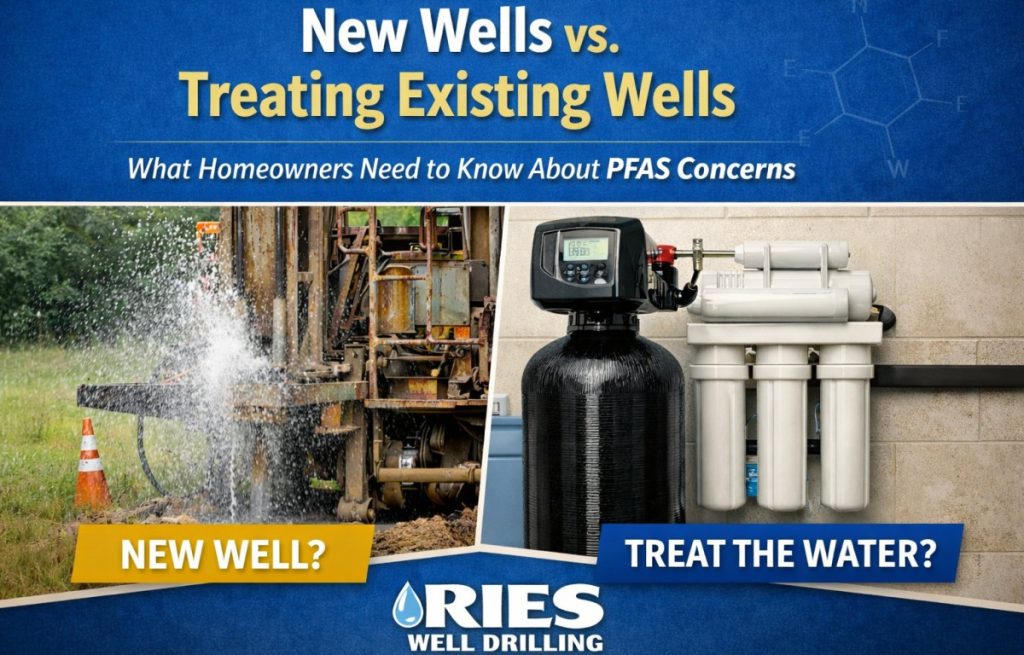
Two commonly used treatment approaches include:
- Whole-house carbon filtration (GAC) to reduce PFAS throughout the home
- Under-sink reverse osmosis (RO) for drinking and cooking water (look for NSF/ANSI 58 certification on RO systems)
A new well may be worth considering in certain situations—especially during new construction or when an older well is experiencing multiple chronic issues. That said, it’s always site-specific and shouldn’t be viewed as a one-size-fits-all solution for PFAS concerns.
Also, many rural well complaints—iron staining, odor, sediment buildup, and pressure swings—typically aren’t due to PFAS. Those symptoms often point to iron/hardness, sulfur, sediment, or pump/tank issues that can be addressed with the right repair or treatment plan.
If you’re building or living on rural property in Romeo, Armada, Ray Township, or Lapeer, the best first step is simple: test your water, then match the solution to your results. Ries Well Drilling can help you choose the right test, interpret lab results, and decide between treatment vs. system upgrades—contact them for a free estimate.
Why This Matters for Private Well Owners (Not City Water)
If your home is connected to city water, the system is routinely tested and managed by a public utility. With a private well in Southeast Michigan, it works differently: you manage it yourself, almost like being responsible for your home’s personal water supply.
No need to panic; that’s simply the reality for rural properties in places like Romeo, Armada, Ray Township, and Lapeer. Your well draws water from local groundwater sources, and the quality can vary based on factors like soil layers, nearby land use, well depth, and how the well was constructed.
This is also why “my water looks fine” doesn’t always tell the full story. Some issues—like sediment or staining—are easy to notice. Others aren’t. PFAS, for example, typically has no taste, smell, or color, so it can go undetected without proper testing.
The good news is that private well owners have more control than they realize. With a sensible testing schedule and the right equipment when needed, you can protect your household, keep the system running efficiently, and reduce the risk of costly surprises down the road.
If you’re planning a new home or maintaining an older well in Macomb, Oakland, St. Clair, or Lapeer County, the approach is straightforward: test first, understand what you’re dealing with, and then choose the solution that best fits your water and your home.
PFAS 101: The “Forever Chemicals” Explained Without the Science Lecture
PFAS are man-made chemicals that have been used for decades in everyday products because they resist heat, oil, stains, and water. They’ve gained much more attention in recent years, largely because they don’t break down easily. Instead, they can remain in the environment for long periods of time—hence the nickname “forever chemicals.”
What Does PFAS Mean (and What Names Might You Hear)?
“PFAS” is an umbrella term that covers thousands of related compounds. Two you’ll hear mentioned most often are PFOA and PFOS. You don’t need to memorize those names, but they may appear in lab results or in articles related to water testing.
The main takeaway for homeowners is that PFAS is typically discussed as a category rather than as a single chemical.
Why PFAS Is Difficult to Detect in Well Water
Many common well-water problems have obvious signs—rust staining, cloudy water, or strong odors. PFAS is different. It typically has no smell, no taste, and no color, which means you can’t detect it the same way you might notice iron, sulfur, or sediment.
Put simply: your water can look perfectly clear and still contain PFAS. If you want a reliable answer, professional lab testing is the only dependable way to confirm what’s in your water.
How PFAS Results Are Measured (Parts Per Trillion)
PFAS is typically measured in parts per trillion (ppt), an extremely precise unit for reporting very small concentrations in water.
Because the numbers can be so small—and because your senses can’t warn you—getting a proper lab test and understanding the results should be the first step before making any filter or system changes.
Southeast Michigan Ground Conditions: Why One Property’s Water Can Differ From the Next
One of the most remarkable aspects of private wells in Southeast Michigan is how much they can vary from property to property—even within just a few miles. Two homes near Romeo, Armada, Ray Township, or Lapeer may have different well depths, water pressure behavior, and water quality results.
That’s not because one well is “good” and the other is “bad.” More often, the difference comes down to what’s below the surface.
Glacial Soils, Sands, Clays, and Gravel Layers
Southeast Michigan was heavily shaped by glaciers. As glaciers moved and melted, they left behind layers of soil, sand, clay, and gravel. Many rural parcels are composed of a patchwork of these materials—almost like a layered cake.
These layers matter because water moves differently through each one. Some materials allow water to pass more readily, while others impede it. The result is that groundwater conditions can change quickly over short distances.
What Does “Shallow vs. Deeper Aquifers” Mean for Homeowners?
Most homeowners don’t need the technical language of aquifers. What matters is simple: when a well is drilled, it draws on groundwater that lies within specific soil and sediment layers. Those layers can influence both the amount of water available and what else can travel with it.
Some wells draw from relatively shallow water-bearing layers, while others are drilled deeper to reach a steadier supply. In either case, well construction details make a significant difference—casing depth, proper sealing, and the well is placement on the property all help protect the water source.
What This Means in Romeo, Armada, Ray Township, and Lapeer
Local variation is why it’s risky to use a neighbor’s well as an accurate reference point. Their well depth, pump setup, and water quality may differ significantly from yours—even if you live on the same road.
For homeowners, the best approach is straightforward:
- Test your water, rather than assuming it’s fine based on appearance alone.
- Plan your well location early during new construction, before grading, landscaping, or outbuildings are finalized.
- Ensure the well is properly constructed and sealed to reduce the risk of surface water and contaminants entering the system.
Southeast Michigan’s ground conditions are one of the main reasons private well systems are not one-size-fits-all. Understanding that variability helps you choose the right well design, pressure setup, and treatment plan for your home.
How PFAS Can Get Into Groundwater
How PFAS Can Get Into Groundwater
PFAS doesn’t simply “appear out of nowhere.” Like many contaminants, it can enter the environment through different pathways and then move with water through soil and sediment layers over time. For private well owners in Southeast Michigan, the key point is that groundwater conditions can vary widely, and surface conditions can sometimes influence conditions underground.
Common Pathways (In Plain English)
PFAS can reach groundwater through several general routes, including:
- Legacy industrial or commercial activity in a region (past use can still matter years later)
- Everyday product and material disposal over time, which may introduce PFAS into the environment
- Runoff and stormwater movement that carries contaminants into the soil
- Water moves downward through soil layers and eventually into the groundwater
- Localized “hot spots” that may affect certain areas more than surrounding ones
- Because details are often site-specific, it’s hard to assess risk based solely on appearance, taste, or a neighbor’s experience.
Why Ground Conditions and Water Movement Matter
Once PFAS is in the environment, it can move with water. How quickly it travels—and how far—can depend on local soil and sediment. Some layers slow water flow, while others allow it to pass more freely. That’s one reason groundwater test results can differ from property to property, even within the same township.
This is also where well construction matters. A properly constructed well helps reduce the chance that surface water or shallow contamination influences the well. Casing depth, sealing methods, and well placement aren’t just “details”—they’re part of protecting the water source.
Note of Caution: PFAS Isn’t the Same as Well Water Smell or Rust Stains
Many rural homeowners begin investigating water quality when they notice obvious issues such as staining, odors, sediment, or low pressure. PFAS typically doesn’t produce those warning signs because it usually has no taste, smell, or color.
Issues like the following are more commonly linked to iron, sulfur, hardness, or sediment—not PFAS:
- Orange staining
- Rotten-egg odor
- Cloudy water
- Grit or sediment buildup
Those problems are still worth addressing, but they usually require a different approach than PFAS treatment.
If PFAS is your specific concern, the best course of action remains the same: test first, then make decisions based on your lab report.
Common Well Water Problems in SE Michigan (And What They Usually Indicate)
Many homeowners in Southeast Michigan begin thinking about water quality when something seems strange—maybe the color changes, there’s a new odor, or pressure drops unexpectedly. The good news is that most common well issues have an identifiable cause, and once you know what’s happening, the fix is often straightforward.
Below are some of the most frequently reported concerns among rural well owners in Romeo, Armada, Ray Township, and Lapeer, what they usually indicate, and the next steps people often take.
Water Quality and Appearance Concerns
Orange or reddish-brown staining (sinks, tubs, laundry)
Staining like this often indicates the presence of iron in the water. Iron can stain fixtures and clothing and may also create a noticeable metallic taste.
White scale buildup on faucets or appliances
This is commonly associated with hard water (high mineral content). Hard water can reduce appliance efficiency and leave residue on dishes, shower doors, and fixtures.
Rotten-egg smell (often strongest in hot water)
This is often linked to hydrogen sulfide (sulfur) or reactions inside the water heater. In some cases, naturally occurring bacteria can also contribute to odor issues.
Cloudy water, grit, or visible sediment
This usually indicates sediment in the system, disturbed well conditions, or changes in the aquifer. Sometimes it’s simply fine sand or silt making its way into the plumbing.
Metallic taste
Metallic flavors are often associated with iron or other dissolved minerals and may occasionally be related to plumbing components in the home.
Pressure and Performance Issues
Low water pressure throughout the house
Low pressure often points to a problem with the well pump, pressure tank, pressure switch, plumbing restriction, or a leak. It can also indicate undersized or aging components.
Pressure that fluctuates (shower gets weak/strong repeatedly)
Pressure swings can indicate a pressure tank issue, control problems, or a system that is cycling too frequently.
Short cycling (pump turning on and off repeatedly)
Short cycling is commonly caused by a waterlogged or failing pressure tank, a system leak, or a pressure switch issue. If left uncorrected, it can shorten pump life.
Air sputtering from faucets
This may indicate air entering the system, changes in the well’s water level, or plumbing-related issues that should be checked out.
Reminder: Symptoms Don’t Always Match the Cause
These symptoms often point toward common sources, but the only sure way to know is through testing and proper diagnosis. Some issues overlap—for example, iron and hardness often show up together, and sediment can appear alongside pressure issues.
If you’re not sure what’s going on, two steps usually bring clarity quickly:
- Get a water test (to confirm what’s in the water)
- Schedule a full well system assessment (pump, tank, and controls)
That combination typically provides a clear, practical path forward—without guesswork.
Step-by-Step: How to Test Your Private Well for PFAS (and Other Essentials)
If you’re concerned about PFAS in your well water—or you simply want more clarity about what’s in it—a proper laboratory test is the first step toward making informed decisions. Testing before purchasing treatment equipment provides an accurate picture of the situation and identifies which solutions are most likely to work.
Below is the process followed by many residential well owners in Southeast Michigan—especially in Romeo, Armada, Ray Township, and Lapeer—when testing private well water.
1) Choose What You Want to Test For
Start by deciding which categories you need:
- PFAS testing (often reported in parts per trillion, or ppt)
- Basic well water screening (commonly includes hardness, iron, pH, and other standard indicators)
- Health-related essentials (often include bacteria and nitrates/nitrites)
If you’re unsure which panels to order, a practical starting point is a basic well screen plus bacteria testing. From there, you can add PFAS testing and any other targeted tests based on concerns, inspections, or project requirements.
2) Locate a Certified/Accredited Laboratory
Use a lab that is certified or accredited for drinking water testing. In Michigan, many homeowners seek labs recognized by state resources or local health department guidance.
A reliable lab should provide:
- The correct sample bottles
- Clear collection instructions
- Proper labeling and handling requirements
3) Order the Correct Sampling Kit and Instructions
Avoid using random containers. PFAS testing, in particular, may require specific bottles and handling protocols. Contact the lab and request a PFAS sampling kit (and any additional kits for bacteria, nitrates, etc.).
Ask the lab for:
- Required bottles and any preservatives (if applicable)
- Step-by-step instructions and do’s/don’ts
- Shipping or drop-off deadlines you must follow
4) Pick the Best Sampling Location in Your Home
Most homeowners use a cold-water tap that represents their drinking water, often the kitchen sink.
Try to avoid sampling from:
- Hose spigots
- Taps with add-on filters
- Water sources that don’t represent what you drink
If the lab provides specific guidance, follow it.
5) Collect the Sample Exactly as the Lab Directs
Follow the lab’s instructions closely. Small mistakes can affect results.
General best practices often include:
- Use cold water
- Don’t touch the inside of the bottle or cap
- Don’t rinse bottles unless instructed
- Fill to the line (if there is one)
- Label everything clearly
For bacterial testing, labs often have strict timing and specific collection steps—follow those directions carefully.
6) Store and Deliver Samples Correctly
Some samples must be kept cool and delivered promptly. Your lab will tell you:
- Whether refrigeration is required
- How quickly the sample must arrive
- Whether same-day drop-off is needed
7) Understand How PFAS Results Are Reported
PFAS results are typically reported in parts per trillion (ppt). Your report may list individual compounds and/or a combined total, depending on the lab and the panel you selected.
If you need help interpreting a report, ask:
- Which PFAS compounds were tested?
- What do the numbers mean for a private well?
- Should I retest or confirm with a follow-up sample?
8) Retest After Any System Change (So You Know It Worked)
If you install treatment equipment or make significant changes to your well system, follow-up testing is the best way to confirm performance. Retesting also helps you set a realistic schedule for future monitoring.
Bottom line: test first, interpret results correctly, and choose solutions based on your actual water results and household usage—not the other way around.
Understanding Your Results: What to Do With a PFAS Lab Report
Receiving a PFAS lab report can feel daunting at first, especially because the numbers are often very small and the terminology isn’t always familiar. The key is not to overreact. Instead, focus on what the report actually shows and what practical step—if any—makes sense next.
What Does “Detection” Mean (and What It Doesn’t)
If your report says PFAS was “detected,” it simply means the lab found measurable levels in your sample. It doesn’t automatically mean there is an immediate emergency, and it doesn’t tell you which solution is best without considering the full situation.
Important reminders:
- PFAS results are typically reported in parts per trillion (ppt).
- Labs may report individual PFAS compounds, a combined total, or both.
- Because different test panels target different PFAS compounds, two reports may not match exactly.
A smart next step is to review any guidance provided with the report, then determine whether a follow-up sample, a treatment plan, or a professional evaluation is appropriate.
Once You Have Results: Questions to Ask
If you’re unsure how to interpret what you’re seeing, asking the right questions can save time and prevent spending money on the wrong equipment.
Helpful questions include:
- Which PFAS compounds were tested, and which were detected?
- Are these results consistent with what you’d expect from a private well in my area?
- Should I retest to confirm the results, and if so, when?
- Does a whole-house approach make sense, or is drinking-water-only treatment more appropriate?
- What maintenance should I expect (e.g., filter changes, cartridge replacements, service intervals)?
- Should I also test for other essentials, such as bacteria, nitrates/nitrites, hardness, and iron (if I haven’t already)?
Retest After Treatment or System Changes
If you install new filtration equipment or make major changes to your well system, a follow-up test is one of the best ways to confirm the system is performing as expected. Retesting also helps you set a realistic monitoring schedule going forward.
Retesting is often especially helpful after:
- Installing whole-house carbon filtration (GAC)
- Adding an under-sink reverse osmosis (RO) unit
- Replacing pumps, tanks, or major plumbing components
- Drilling a new well or upgrading an existing well system
The Goal: Clear Information, Then a Practical Decision
A PFAS report doesn’t have to be confusing or intimidating. The goal is simple: use test results to make a clear, practical decision—whether that means confirming the findings with a retest, choosing the right treatment approach, or getting help from a professional who understands private well systems.
If you’d like a second set of eyes on your PFAS report, Ries Well Drilling can help you interpret the results and outline realistic options based on your home’s water needs.
Treatment Options That Actually Make Sense for Homeowners
Once your lab results are in, the next step is selecting an effective treatment option that fits your water, household usage, and goals. The best plan isn’t always the most expensive one. What matters is that the system is properly sized, installed correctly, and maintainable over time.
Here are the main approaches homeowners typically consider when PFAS is a concern, along with what each option involves.
Option 1 — Whole-House Carbon Filtration (GAC)
Granular Activated Carbon (GAC) is one of the most popular “whole-house” approaches when homeowners want PFAS reduction at multiple taps throughout the home. A properly sized system is usually installed where water enters the house, treating water used for showering, laundry, dishwashing, and general household use.
Why homeowners opt for it:
- Treats water throughout the home for everyday use
- Often considered when PFAS reduction is desired beyond drinking water
- Once installed, it runs quietly in the background (with routine maintenance)
Keep this in mind:
- Sizing matters. Higher water usage requires proper sizing for reliable performance.
- Like any filter media, carbon must be replaced on a schedule to remain effective.
- Follow-up testing helps confirm performance and determine maintenance intervals.
GAC can be a strong option for homeowners who want a broader, whole-home approach rather than focusing only on drinking water.
Option 2 — Under-Sink Reverse Osmosis (RO) for Drinking Water
Reverse Osmosis (RO) systems are a popular choice for improving drinking and cooking water. Installed under a kitchen sink (or at a dedicated faucet), RO systems provide treated water specifically for consumption.
Why homeowners opt for it:
- Targets drinking and cooking water directly
- Point-of-use treatment can be a practical option for many homes
- Can be combined with other treatment approaches when needed
Notes to keep in mind when choosing an RO system:
- Look for RO options with NSF/ANSI 58 certification.
- RO systems require periodic replacement of filters and membranes.
- Evaluate available under-sink space and expected water use ahead of time.
RO can be a convenient solution for homeowners who want to treat the water they use for drinking and cooking.
GAC or RO: Which Option Suits Your Needs?
Your choice depends on your goals and how you want the treatment to function day-to-day.
Whole-house GAC may make more sense if:
- You want treatment at multiple fixtures throughout the home
- Your goals include showering, laundry, and general household water use
- You prefer a whole-home “set it up and maintain it” approach
Under-sink RO may make more sense if:
- Your top priority is clean drinking and cooking water
- You want a manageable solution in one location
- Routine filter and membrane replacements are acceptable to you
Many homeowners choose a hybrid approach—for example, installing a whole-house system for broader reduction, plus an RO unit specifically for drinking and cooking water.
Verify Performance With Follow-Up Testing (Verification Is Key)
No matter which approach you choose, one important step often overlooked after installation is confirming performance. Follow-up testing helps you:
- Verify the system is reducing PFAS as intended
- Set a maintenance schedule based on real results
- Avoid replacing filters too early—or too late
At its core, choosing the right treatment option comes down to matching your lab results with a system that fits your home, your routine, and your maintenance comfort level.
When a New Well Might Be Considered (and When It Might Not)
Homeowners concerned about PFAS often wonder whether drilling a new well would be the most sustainable long-term solution. In certain situations, a new well may be part of the conversation. In many others, treating the existing water supply is the more practical and cost-effective choice.
There is no universally correct answer for “new well.” The right decision depends on factors such as your property, the condition of your existing well, and local groundwater conditions.
Situations Where It May Be Worth Discussing a New Well
A new well may be worth considering when:
- You’re building a new home, which gives you more flexibility with location, depth, and overall system design.
- Your existing well is aging and requires frequent repairs, or it has multiple recurring issues.
- Your water needs have changed due to additions such as bathrooms, irrigation, outbuildings, or hobby-farming demand.
- A well upgrade fits into a broader plan, like improving reliability, reconfiguring the pressure system, or replacing plumbing lines.
A new well shouldn’t be considered only from a water-quality standpoint. Performance, reliability, and long-term lifespan should also be part of the decision.
Why Construction Details Matter
If a new well is being considered, construction details matter just as much as the drilling itself. Proper construction helps protect the water source and reduces the chance of surface water influence.
Key construction factors typically include:
- Correct casing depth and proper sealing/grouting methods
- Well placement that meets the required setbacks
- A protected wellhead area with a sanitary well cap for added protection and cleanliness
Careful design and construction can also make a well easier to maintain over time and less prone to avoidable issues.
When a New Well May Not Be the Ideal Choice
In some cases, an alternative approach may make more sense, such as when:
- Your existing well is otherwise reliable.
- Treatment options like GAC or RO can meet your goals.
- The cost and disruption of drilling don’t provide a meaningful advantage.
- There’s no clear evidence that a new well would address PFAS concerns without additional data.
It’s also important to remember that drilling a new well doesn’t automatically eliminate the need for testing or treatment. In many cases, treating the water you already have—and confirming results through follow-up testing—can be the more efficient path.
Bottom Line
A new well can be a smart long-term investment during new construction or when an older well is causing ongoing problems. But it should always be a case-by-case decision based on real data, proper evaluation, and a clear understanding of what will actually improve water quality and system performance.
New Construction Planning in Romeo, Armada, Ray Township, and Lapeer: Do This Early
If you’re building on rural land in Romeo, Armada, Ray Township, or Lapeer, planning your well system should happen early—ideally before final grading, driveways, landscaping, and outbuildings are locked in. Starting early helps you avoid costly changes later and ensures the system aligns with your plans for living on the property.
Coordinate Well and Septic Layouts From the Start
One of the most common new-build mistakes is treating the well and septic as separate projects. In reality, they affect each other. If one location shifts, it can impact the other, and setback requirements can force last-minute changes.
Planning ahead helps you:
- Choose practical locations that meet required setbacks
- Avoid placing components where future patios, decks, or additions could interfere
- Reduce headaches once excavation and grading are underway
Think Ahead About Water Demand (Not Just “One House, One Well”)
New construction is the best time to plan for current and future water usage. Many rural homeowners end up adding things that increase demand, such as:
- Larger tubs or multiple showers
- Irrigation systems and outdoor spigots for gardens
- Pole barns, workshops, or additional hydrants
- Hobby farming needs (animals, wash-down areas, etc.)
Designing for realistic usage helps prevent pressure problems and reduces wear on pumps and tanks.
Choosing the Right Pressure System for Modern Living
Pressure expectations differ today from those of 20–30 years ago. A well-designed system can significantly improve daily comfort—especially in larger homes or those with multiple bathrooms.
Some homeowners also choose constant-pressure systems, which are designed to reduce pressure swings and provide more consistent pressure during normal household use.
Keep the Wellhead Accessible for Future Service
A well system needs to be serviceable. You don’t want the wellhead buried in landscaping or blocked by new structures.
When planning placement, consider:
- Easy access for future maintenance and service
- A wellhead area that can be kept clean and protected
- Location that won’t be boxed in by fences, decks, additions, or grading changes later
A Simple New-Build Checklist
Before your build is too far along, make sure you can answer these questions:
- Where will the well go—and can a drilling rig access it easily?
- Where will the septic system go—and are setbacks accounted for?
- What’s your realistic water demand now and in the future?
- Do you want standard pressure or a more consistent pressure approach?
- Will outbuildings, irrigation, or hobby farming increase your water needs?
Making these decisions early helps create a well system that’s reliable, efficient, and ready for long-term use—without last-minute surprises.
FAQ
Can you smell or taste PFAS in well water?
No. PFAS typically has no taste, smell, or color, so you can’t identify it just by looking at your water or relying on your senses. A lab test is the only reliable way to confirm the presence of PFAS.
Can boiling water eliminate PFAS?
Boiling generally does not remove PFAS and may even increase concentrations by reducing water volume through evaporation. If PFAS is a concern, treatment decisions should be based on lab results and the appropriate filtration method.
How often should a private well be tested?
A practical testing plan includes regular checks and additional testing whenever conditions change—new odors, staining, sediment buildup, pressure changes, or after major system work. Many homeowners also test during home purchases, new construction, and before installing filtration equipment.
Are water softeners and PFAS filters the same thing?
No. A water softener is designed to remove hardness (minerals such as calcium and magnesium). PFAS reduction typically involves options such as whole-house carbon filtration (GAC) and/or under-sink reverse osmosis (RO), depending on your goals and lab results.
Which is better: whole-house carbon (GAC) or under-sink reverse osmosis (RO)?
It depends on what you’re trying to accomplish. GAC treats water throughout the home and is often considered when broader reduction is desired. RO is typically focused on drinking and cooking water at a single location. Many homeowners choose a combination approach based on their results and household needs.
Should I install treatment before testing?
Testing should come first. Without results, it’s easy to buy the wrong system or size it incorrectly. Testing helps you choose a solution that meets your water needs and prevents unnecessary spending.
If I drill a new well, will I still need treatment?
Not necessarily—but it’s possible. A new well is not a guaranteed solution to PFAS or other water quality concerns. Whether treatment is needed depends on the new well’s water quality, which should be confirmed with follow-up testing after drilling.
Ries Well Drilling: Local Experience, Straight Answers
Ries Well Drilling has been family-run since 1983, providing practical, no-nonsense solutions for private well systems throughout Southeast Michigan. Whether you’re building on rural land in Romeo, Armada, Ray Township, or Lapeer, or you’re dealing with an older well that’s starting to show problems, Ries can help you get clear answers and a system you can rely on.
If you already have PFAS test results—or you’re not sure which tests to run—Ries can help you interpret the report and talk through real-world options. That may mean improving an existing well system, installing the appropriate treatment system, or designing a comprehensive well plan for new construction.
If you’d like guidance on the next step, contact Ries Well Drilling for a free, accurate estimate. You’ll receive straightforward recommendations based on your water usage, household needs, and what makes the most sense over the long term.
Call 586-784-9516 now for a FREE estimate – fully insured and licensed, family-owned and serving Southeast Michigan since 1983!